

Home / British mammals / Alcathoe bat
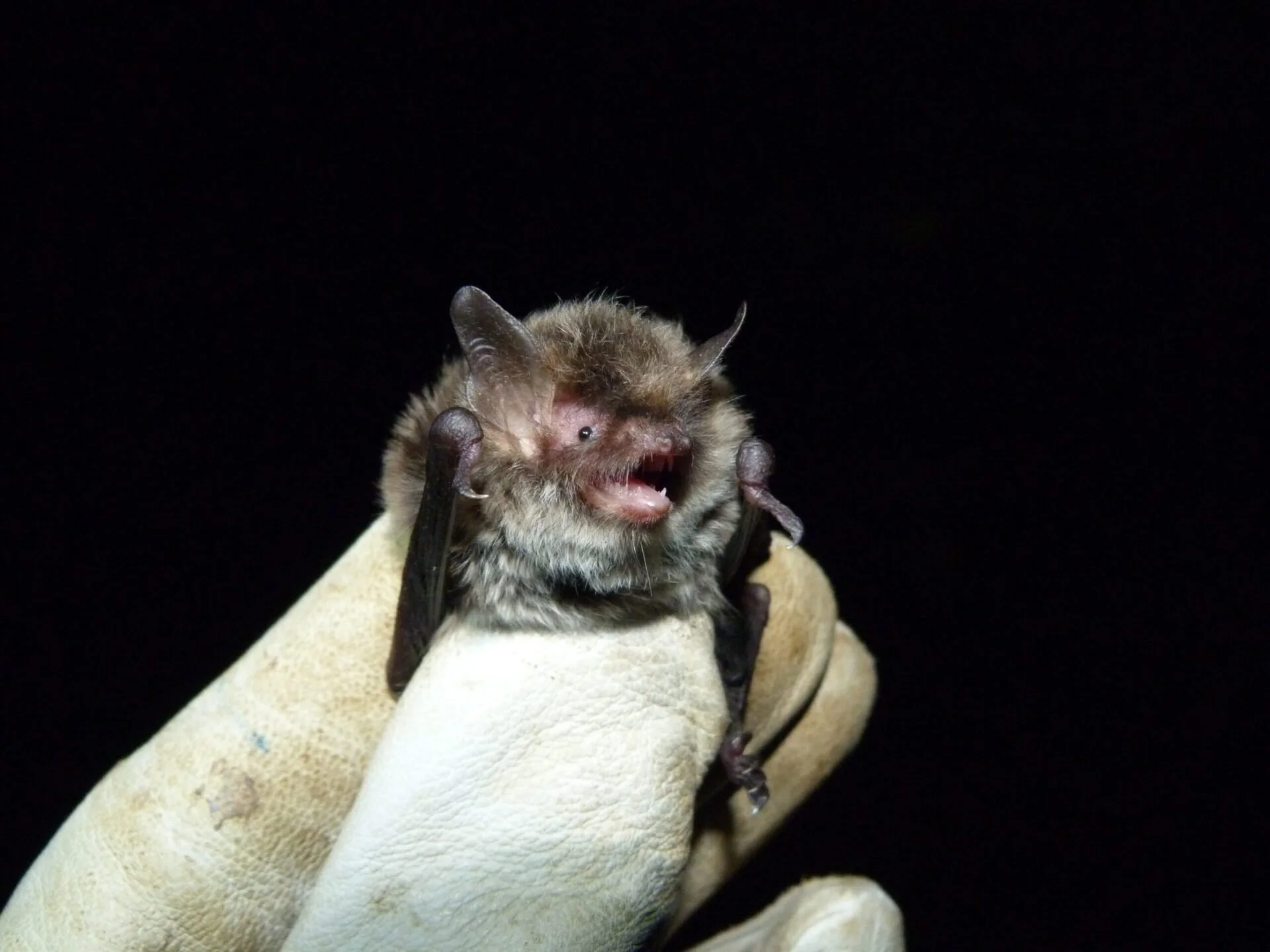

Alcathoe bat
Scientific name: Myotis alcathoe
Conservation status: UK Red List
GB: Data Deficient
England: Data Deficient
Scotland: Data Deficient
Wales: Data Deficient
Global: Data Deficient
Habitat: Broadleaved, Semi-Ancient and Oak woodland, Scrub, Parkland
Description: Typical fur coloration for Myotis bats with pale underparts, darker fur on upper surfaces and a pointed tragus.
Size: Smallest of the Myotis bat species.
Origin and distribution: Native. Due to their close similarity to the whiskered and Brandt’s bat, they were only confirmed in the UK in 2010. This results in no historical records of this bat in the UK. Due to similarities in appearance and echolocation to other bats, their distribution is likely larger than known. Populations are found in Sussex and Surrey; however, they have been found in Yorkshire, Kent, Jersey, Hampshire, and Wiltshire. None have been identified in Wales, Scotland, or Northern Ireland.
Diet: Information on their diet in the UK is unknown, however, it is expected to be like European populations which feed on moths, flies, and ants, and particularly, mosquitoes.
General ecology: This is a woodland specialist. Maternity roosts that have been identified in the UK are almost exclusively found in splits, cracks, and loose bark of trees, particularly oaks. One has been found in a building in Surrey. They do not appear to occupy bat boxes. Colonies of these bats fragment into small satellite roosts, with the largest number of bats being 96 individuals. There is only one recording of this species hibernating underground. Hunting areas are usually within 3km of the roost.
Breeding: Maternity colonies include 15-100 individuals, but these typically fragments so that roosts are smaller in size. Comprised of almost entirely female bats.
Conservation status: These bats are classified as data deficient on the IUCN Red List and future population trends are unknown.
Identification
The smallest of the Myotis bat species. Typical fur coloration for Myotis bats with pale underparts, darker fur on upper surfaces and a pointed tragus. They have a blunt muzzle. DNA analysis is often required to properly identify these bats from the whiskered and Brandt’s bat.
Identification definitions:
Muzzle: Projecting part of face, including nose and mouth.
Tragus: Piece of skin near the ear canal.
Bat Detector
Range: 43-120 kHz
Most energy:
Average duration: 2.5 ms
Confusion species: Other Myotis bats, particularly, M. mystacinus (whiskered bat), and M. brandtii (Brandt’s bat).