

Home / British mammals / Bechstein’s bat

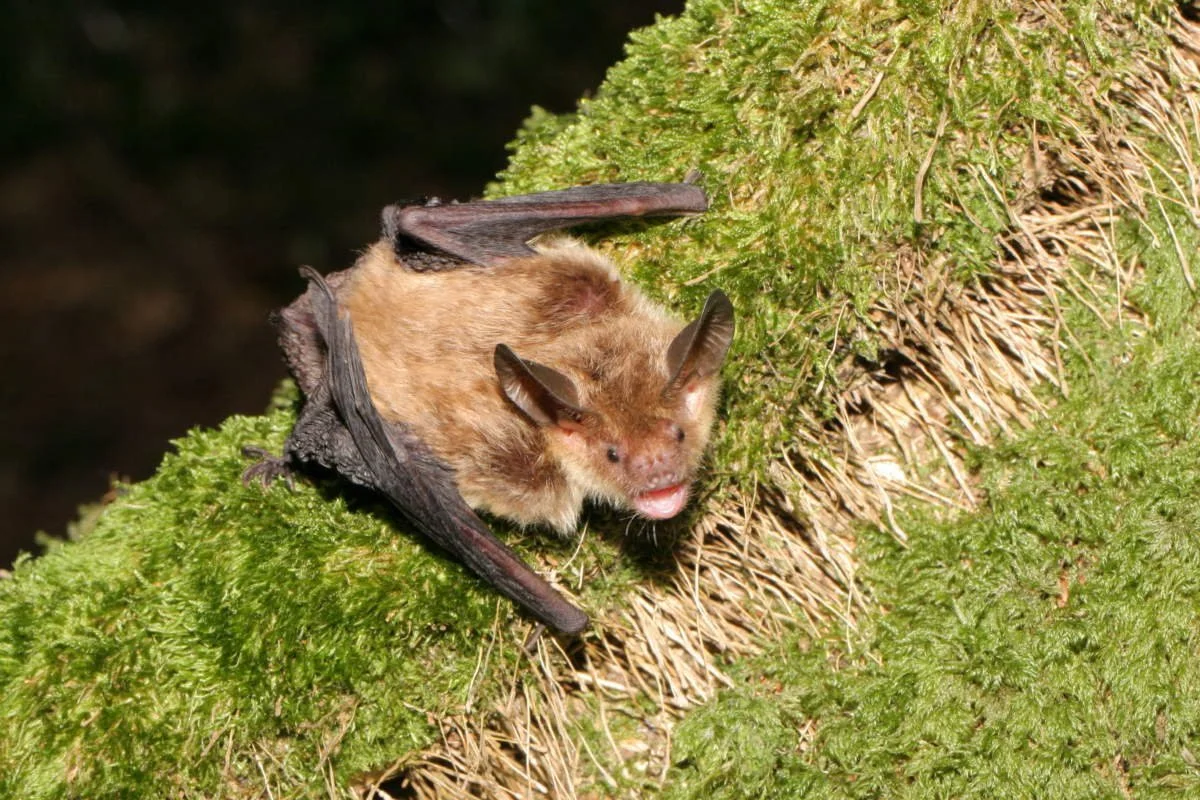
Bechstein’s bat
Scientific name: Myotis bechsteinii
Conservation status: UK Red List
GB: Least Concern
England: Least Concern
Scotland: Least Concern
Wales: Least Concern
Global: Least Concern
Habitat: Deciduous Woodlands, Semi-Natural Ancient Woodland, Oak, Hedgerows, Wooded Riparian Corridors.
Description: Medium sized bat for the Myotis bat species with long ears and a short muzzle. The are darker in coloration on their backside, than their underside.
Origin and distribution: Native. Found in southern regions of the UK, from Kent to Devon and extending northwards to Gloucestershire, Herefordshire, and Worcestershire. The population extends just inside South Wales with the first maternity roost identified in 2018. They are absent from northern England, Scotland, and Northern Ireland.
Diet: Moths, and woodland-associated flies. Others, in smaller quantities, include centipedes, earwigs, ground beetles, and harvestmen.
General ecology: Favours foraging in wooded riparian corridors, with foraging distances being around 700m on average (relatively small compared to other bat species). Evidence of sexual segregation whilst foraging, with females utilising optimum foraging areas. Mostly a gleaning species (takes food from a surface) feeding on non-flying insects. Their maternity and solitary roosts are almost exclusively in woodland trees, mostly in woodpecker and rot holes in oak trees. They have been caught in low numbers swarming (peak in mid-August) at man-made and underground structures. Few individuals are found hibernating.
Breeding: Maternity roosts are found in trees but will occasionally use bat boxes. Female Bechstein’s bats will often return to the same colony they were born in. Whereas half of males near maternity roosts are immigrants and local males’ father fewer than 25% of offspring. Females are known to travel large distances to swarming sites, where mating activity likely occurs.
Conservation status: For most of their natural range in the UK these bats are classified on the IUCN Red List as Least Concern, however, in Wales they are classified as Endangered. Globally, they are considered Near Threatened. The population trends are currently unknown for these bats. However, their habitat is declining, and they are particularly vulnerable to habitat fragmentation.
Identification
Ears are long and do not meet in the middle of the head. Their muzzle is much shorter than their ears. The tragus is spear-shaped, and the fur is pale on the underside and darker on their backs. The calcar is straight and there is no fringe of hairs along the trailing edge of the tail membrane.
Identification Definitions
Muzzle: Projecting part of face, including nose and mouth.
Tragus: Piece of skin near the ear canal.
Calcar: Ancle spur.
TailMembrane: Skin connecting the tail to the feet.
Bat Detector
Range: 50-60 kHz
Most energy: 61 kHz
Average duration: 3.3 ms
Confusion Species
Other Myotis bats, particularly, M. mystacinus (whiskered bat), and M. brandtii (Brandt’s bat).