

Home / British mammals / Chinese water deer


Chinese water deer
Scientific name: Hydropotes inermis
Small, compact deer, pale fawn with large rounded ears and conspicuous button-black eyes. The males (bucks) have no antlers, but have long tusk-like canines. Slightly taller, and much paler than muntjac and lacks the hump-backed look. Appears more like a diminutive roe deer.
Conservation status: UK Red List
GB: N/A
England: N/A
Scotland: N/A
Wales: N/A
Global: Vulnerable
Summary
Habitat: Urban & gardens, rivers and wetland, coastal & marshland, deciduous woodland, grassland, arable land
Size: 82-106 cm; tail length 2.5-9 cm; shoulder height 42-65 cm.
Weight: Males 12-18.5 kg; females 14-17.4 kg.
Lifespan: Known to live at least six years.
Origin and distribution
The Chinese water deer is native to E China (Yangtze flood plain) and Korea. They were introduced to Woburn Park, Bedfordshire, in 1896, and Whipsnade Zoo in 1929-30. They were deliberately released into surrounding woodlands from 1901 onwards, but there have been numerous releases, translocations, and escapes. The Chinese water deer was first reported in the wild in Buckinghamshire in 1945. They have a limited range in East Anglia and adjacent counties and are still spreading. However, they have not reached as wide a range or abundance as Reeves’ muntjac. Some colonies seem to have died out, and also seems to have been displaced in some places by muntjac.
Water deer seem to prefer wetlands adjoining woodland and fen, though they often range onto nearby farmland. They are most evident in the Norfolk Broads and in the coastal wetlands. A feral, uncontained, population in the grounds of Whipsnade inhabits parkland and dry woodland, with no wetland available.
Diet
They feed mostly around dawn and dusk, on weeds, grasses, herbs and some browse. Although they often feed in arable fields, they seem to be eating weeds rather than crops.
Ecology
Bucks and does are territorial, marking twigs with scent from the prominent preorbital gland. Dung piles around the territory boundary also seem to be markers. Water deer do not form herds, but are seen either solitarily or in family groups of a doe with her fawns. Loose groups may come together on favoured feeding areas.
Breeding
The rut is in December, when males fight viciously with their tusks. The female often has twins, sometimes up to 4 fawns, after a gestation of 160- 210 days. Fawns are born in May-June, and although they are weaned in about 3 months, remain with their mother into winter. They then disperse, but mortality at this time is high, and although they become sexually mature, young seem to have difficulty maintaining a territory.
Conservation Status
Chinese water deer have not, so far, posed the problems that are caused by muntjac. Densities are typically much lower (at around 10/km) and the habitats they occupy are less sensitive to browsing damage. Road mortality seems to be important, and some are shot.
Identification
Small deer with sandy brown coat in summer, paler in winter with rump same colour and a stumpy tail. No antlers but males have long curved tusks (upper canine teeth) protruding past the lip.
Footprints: Chinese Water Deer have small footprints, only muntjac have smaller prints. Width 3-4cm, length 4-5cm. However, be very careful not confuse these with sheep or goat footprints.
Droppings: Deer droppings do not have obvious coloration or smell. The droppings tend to be of a similar shape across all species.
Tail: The Chinese water deer has a dark rump, but most importantly, only a very small stumpy tail.
Confusion species

Red deer (Cervus elaphus)
Buff coloured rump with ginger buff tail. Fallow has a white rump with a black horseshoe-shaped border and a long black tail (giving the appearance of the number 111). Typical fallow coat has spots all year round (although coats can vary greatly in fallow), no spots on red deer. Large, branched antlers in red, not palmate (broad and flattened) as in fallow deer.

Red deer (Cervus elaphus)
Red deer are much larger than roe. They have a buff-coloured rump with a ginger buff tail. Roe deer have a similar coat colour, though red deer's appear more red. Red deer have very large branched antlers in mature males, whilst roe have much smaller antlers with usually no more than 3 points. Roe also have a distinctive black nose and white chin.

Sika deer (Cervus nippon)
Sika deer have a heart-shaped white rump with a black upper border, a white tail and a thin black vertical streak, whilst roe have a plain cream/white rump with no visible tail. Sika have a brown coat with distinctive spots in the summer with coat turning greyer in winter, whilst roe have a red/brown coat in summer and grey/brown in winter. Roe have a distinctive black nose and white chin which sika do not have.
Muntjac deer (Muntiacus reevesi)
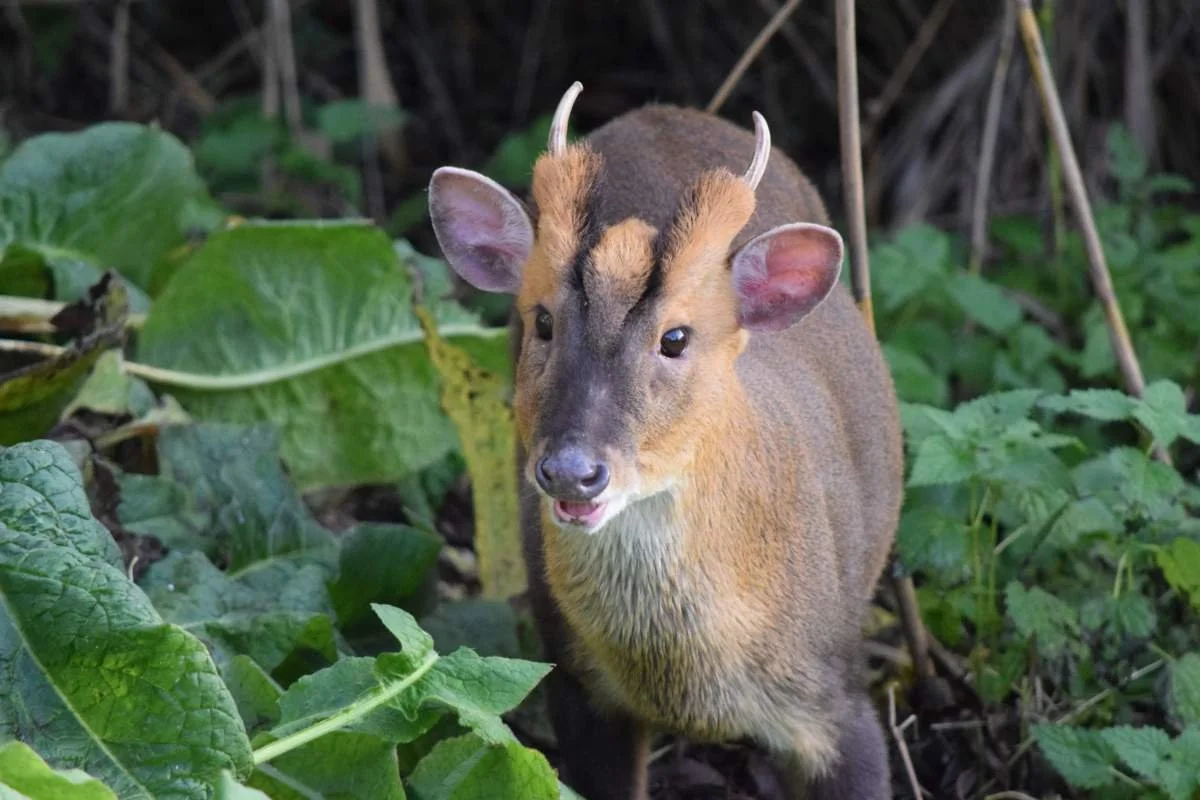
Tail held vertical when alarmed to show white underside, chinese water deer does not do this. Male has short single spike antlers pointing backwards, non-existent in chinese water deer. Males also have ‘tusks’ (upper canine teeth) protruding about 2cm below lip. These are much smaller than the chinese water deer’s tusks, which reach around 7cm below the lip. Muntjac has two vertical stripes down the face, on the inside of each eye. It is often said that chinese water deer face looks like a teddy bear.