

Home / British mammals / Fallow deer

Fallow deer
Scientific name: Dama dama
A medium-sized deer, similar to sika (intermediate between roe and red deer). Typically has a spotted coat, with a longer tail than other deer, constantly twitching. There is a white “target” with black margins, and a black stripe down the tail. Males have palmate antlers. However, fallow deer are very variable in colour; some are white, others very dark brown (conventionally called “black fallow”), and a variety known as Menil, spotted but with the edges to the rump patch and tail stripe brown, rather than black.
Conservation status: UK Red List
GB: N/A
England: N/A
Scotland: N/A
Wales: N/A
Global: Least Concern
Summary
Habitat: Deciduous woodland, grassland, mixed woodland
Size: 138-179 cm; tail length 14-21cm; shoulder height 50-120 cm.
Weight: Males 40-63 kg; females 31-44 kg.
Lifespan: Usually 8-10 years in the wild, females 12-16 years.
Origin and distribution
Fallow deer are native to SW Asia, but were anciently (9,000 years ago) introduced to the Mediterranean region. They were introduced to England by the Normans around 1100 AD. They make better park deer than the larger red deer, so were subsequently widely spread through Britain and Ireland. Escapes from parks, and some direct releases into hunting forests, have seen the fallow established very widely, and they are the most common deer in England. They are also widespread in Scotland, Wales and Ireland.
Diet
Grasses contribute around 60% of the diet, also herbs and boradleaf browse of young trees. They will take acorns, chestnut, beech mast and fruits in Autumn. If grazing limited, they will take bramble and conifer.
Ecology
They typically live in small herds of 10-50 animals, usually in open woodland and parkland. They also frequent small woodlands in farming country, sheltering in the woodland by day and emerging to feed on farmland at night. During the rut in October, fallow bucks become territorial, groaning and defending a rutting stand where the does visit them to mate.
Breeding
Fawns are born in June-July, after a gestation of 234 days. They are weaned by the time of the next rut, and the does usually first breed as yearlings. Outside the rut, bucks often live in small bachelor herds (5-10), separately from the does and fawns.
Conservation status
Fallow deer can be a serious pest in commercial forestry. As the commonest deer, they can also be a pest in farmland, and are a common cause of road accidents. Populations in forestry can be culled by stalkers, in the conventional manner, and the venison sold. This is effective in parts of southern Britain where it has limited the spread and increase of this deer.
Identification
Medium-sized deer. Nearly always seen moving together in herds. Coat colour varies greatly, even in same herd. Typical coat is brown with white spots in summer and lighter brown with white spots in winter. Individuals may be white or near black. Longer tail than other deer, constantly twitching. Rump is white with black margins either side, and black stripe down the tail, giving appearance of the number 111. Fully grown males have large, broad, flattened antlers.
Footprints: Fallow deer have very similar footprints to the sika deer. They are one of largest footprints of all deer species. Width of female footprints up to 4cm and the length 6cm. They can be easily confused with sheep and goat footprints.
Droppings: Deer droppings do not have obvious coloration or smell. The droppings tend to be of a similar shape across all species.
Tail: The fallow deer tail has heart shaped white markings with an upside down horseshoe shaped black border and a long black tail.
Confusion species

Red deer (Cervus elaphus)
Buff coloured rump with ginger buff tail. Fallow has a white rump with a black horseshoe-shaped border and a long black tail (giving the appearance of the number 111). Typical fallow coat has spots all year round (although coats can vary greatly in fallow), no spots on red deer. Large, branched antlers in red, not palmate (broad and flattened) as in fallow deer.

Red deer (Cervus elaphus)
Red deer are much larger than roe. They have a buff-coloured rump with a ginger buff tail. Roe deer have a similar coat colour, though red deer's appear more red. Red deer have very large branched antlers in mature males, whilst roe have much smaller antlers with usually no more than 3 points. Roe also have a distinctive black nose and white chin.

Sika deer (Cervus nippon)
Sika deer have a heart-shaped white rump with a black upper border, a white tail and a thin black vertical streak, whilst roe have a plain cream/white rump with no visible tail. Sika have a brown coat with distinctive spots in the summer with coat turning greyer in winter, whilst roe have a red/brown coat in summer and grey/brown in winter. Roe have a distinctive black nose and white chin which sika do not have.
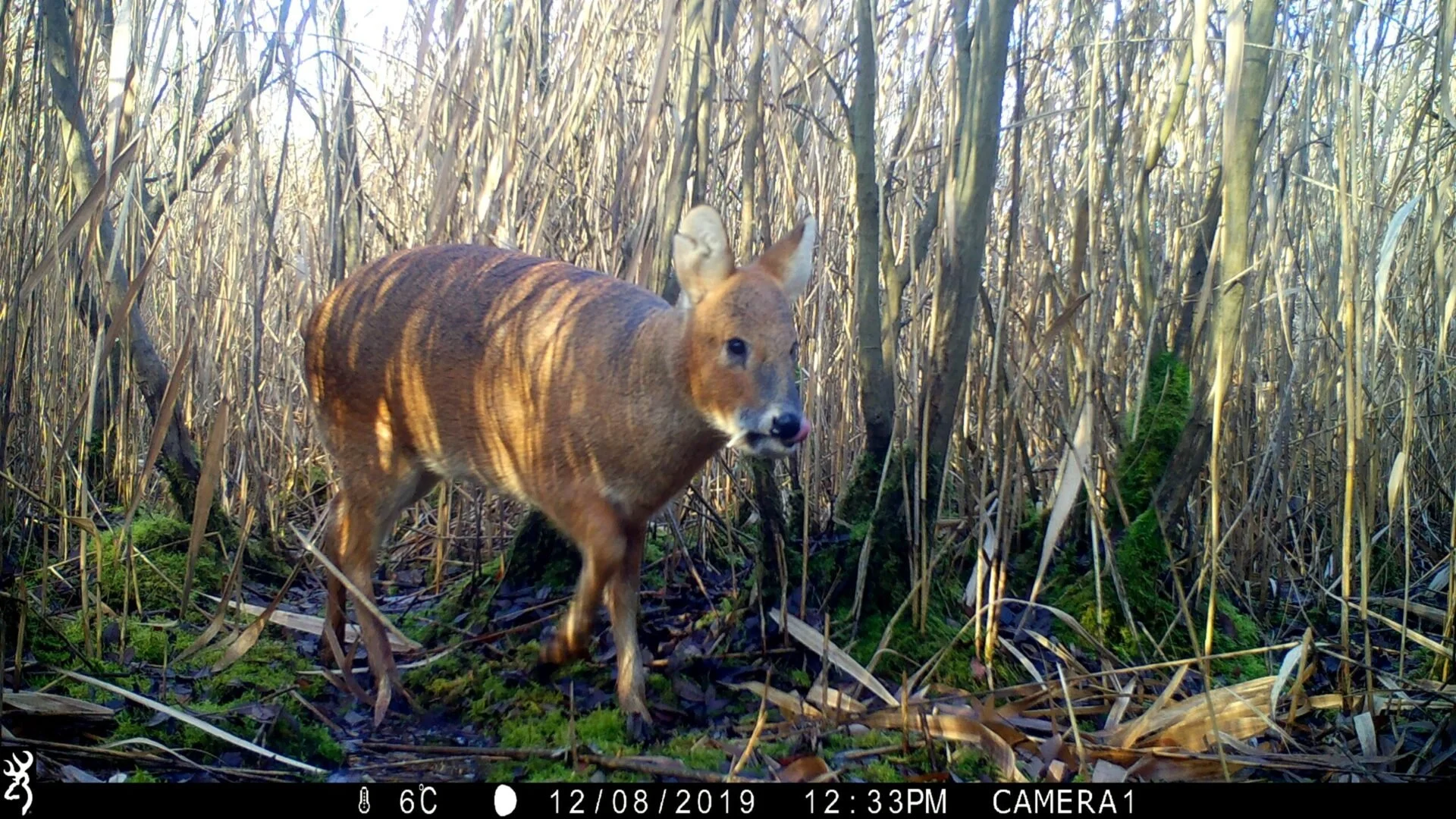
Chinese water deer (Hydropotes inermis)
Chinese water deer have a rump the same colour as the rest of their coat and a stumpy tail, whilst roe have a cream/white rump with no visible tail. Chinese water deer has tusks (protruding upper canine teeth) whereas roe does not. Chinese water deer have no antlers, whilst roe have small, pointed antlers, with no more than 3 points. It is often said that the faces of Chinese water deer look like teddy bears, whilst roe have a distinctive black nose and white chin.