

Home / British mammals / Grey long-eared bat

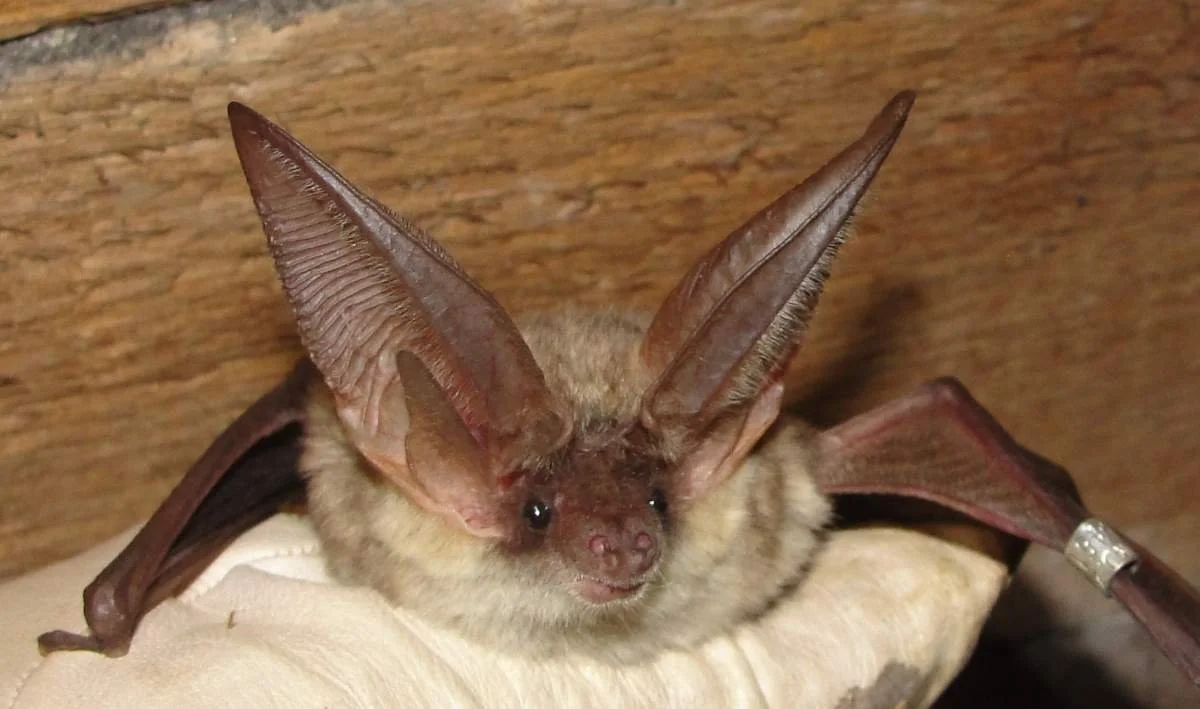
Grey long-eared bat
Scientific name: Plecotus austriacus
Conservation status: UK Red List
GB: Endangered
England: Endangered
Scotland: Not Assessed
Wales: Not Assessed
Global: Least Concern
Habitat: Meadow, Wet Pasture, Woodland, Grassland
Description: A cryptic species that is very similar in appearance to the brown long-eared bat.
Origin and dstribution: Native. Very few confirmed records most of which are from areas close to the coast in lowland areas of southern England and the Isle of Wight. They are absent from Scotland and Northern Ireland. They are regarded as absent from Wales, however, there has been a single genetic record in Pembrokeshire which could not be fully confirmed.
Diet: Mostly preys on moths.
General ecology: No hibernation sites have been identified. Emerge late and feed mainly on moths, foraging over meadows and along woodland edges. Colony home ranges can vary between locations (15-35 km2), which may be affected by the quality of foraging habitat.
Breeding: All maternity roosts in Great Britain are in the loft spaces of residential buildings. Maternity colonies are generally small.
Conservation status: Registered as Endangered in Great Britain and England and as Least Concern globally on the IUCN Red List. Both this species population and habitat are in decline. The loss of wet and species-rich meadows is the predominant cause of population decline of this species. Other reasons include loss of roosts due to urbanisation and barn conversions, road casualties, and artificial night lighting.
Identification
The grey long-eared bat is very similar in morphology (physical appearance) and flight pattern to the brown long-eared bat. However, they have a darker face and muzzle, wider tragus, and shorter thumbs. Droppings can only be identified using genetic analysis.
Identification Definitions
Muzzle: Projecting part of face, including nose and mouth.
Tragus: Piece of skin near the ear canal.
Bat detector
Range: 18-45 kHz
Most energy: 28 kHz
Average duration: 5.8 ms
Confusion species
Likely to be confused with Plecotusauratus (brown long-eared bat) and Barbastellabarbastellus (Barbastelle Bat).