

Home / British mammals / Grey seal
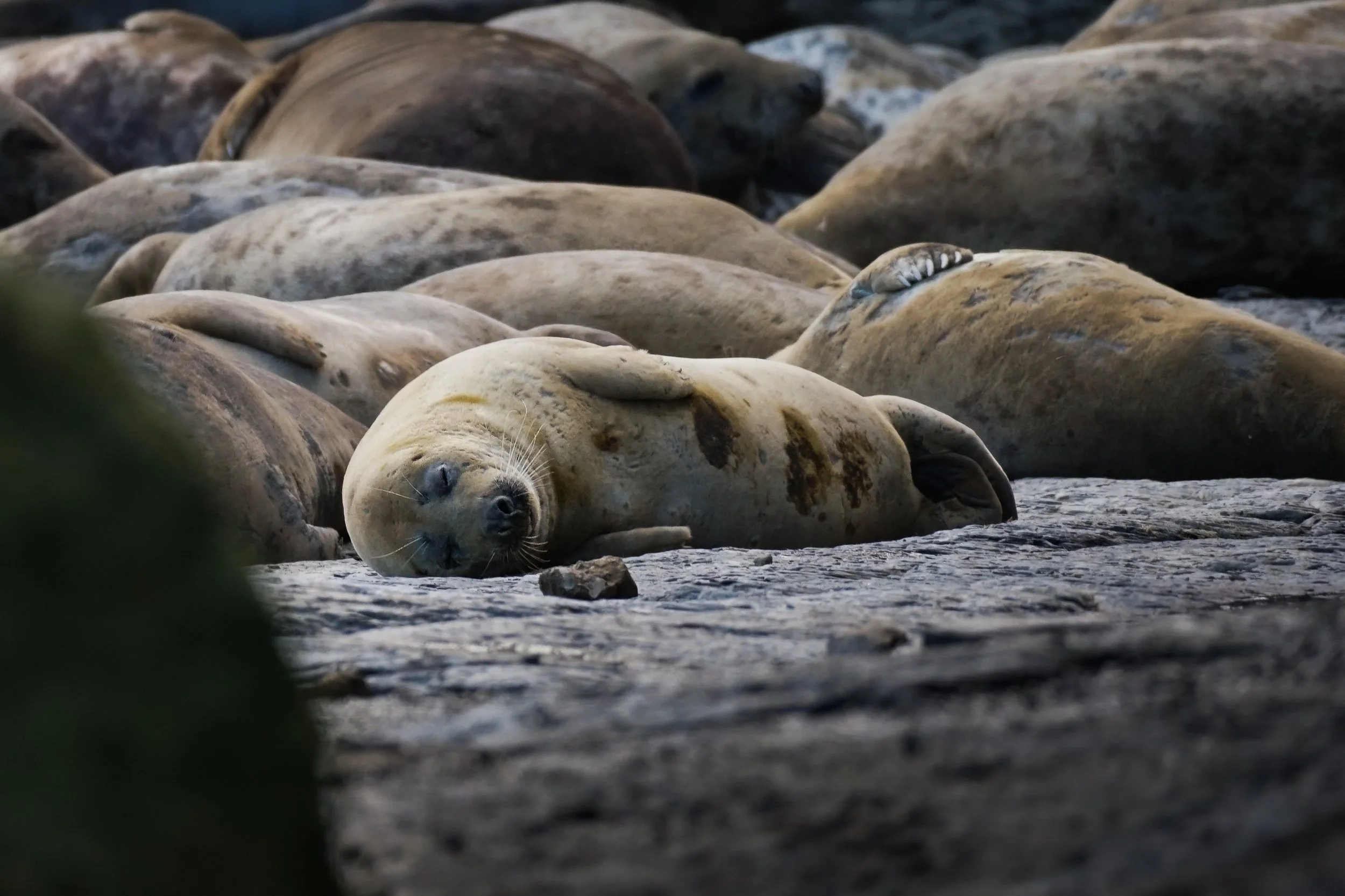
Grey seal
Scientific name: Halichoerus grypus
Grey seals are the largest land breeding marine mammal in Britain. They are a “true seal” or “earless seal”, therefore their ears do not have flaps to avoid heat loss. Their latin name, Halichoerus grypus, means “hook-nosed sea pig”. In the United States the grey seal is also known as the Atlantic seal and the horsehead seal.
Taxonomy Chart
Animalia – Chordata – Mammalia – Carnivora – Pinnipedia – Phocidae – Halichoerus
Conservation Status: UK Red List
GB: Least concern
England: Least concern
Scotland: Least concern
Wales: Least concern
Global: Least concern
Summary
Diet: Fish are the main staple, including sand eels, dragonets, hake, whiting, cod, haddock, pollock and flatfish. They also prey on crustaceans, squid and octopuses. Seals eat more tonnes of sand eels and dragonets than any other species of fish.
Habitat: Grey seals tend to feed in inshore benthic habitat (near the seabed). They use remote bays, caves, beaches and islands as “haul out” areas to rest, digest, socialise and give birth to pups.
Size: Weight: females 155kg, males 300kg. Size: females 1.8m long, males up to 2.8 metres.
Lifecycle: Females can live up to 30 years, but males seldom survive beyond 25 years of age.
Conservation concerns: Human impacts such as climate change, overfishing, pollution, habitat loss, disturbance, bycatch/entanglement and toxic algal blooms.
Terminology
Pinniped: Any of a group of aquatic mammals in the order pinnipedia. Pinniped means fin- or flipper-footed and refers to marine mammals that have front and rear flippers. This group includes seals, sea lions and walruses - animals that live in the ocean but are able to come on land for long periods of time.
Blubber: A thick layer of fat found under the skin of marine mammals.
Bull: An adult male seal. A dominant male is called a beachmaster.
Cow: An adult female seal. A dominant female is called a matriarch.
Adult seals are over 5 years old, juveniles are between 1 and 5 years, moulted pups 3 weeks to a year and white coated pups up to 3 weeks old.
Unihemispheric sleep: Half of the brain sleeps whilst the other half carries out vital functions such as returning to the surface for air. As opposed to ‘bihemispheric’ sleep where both hemispheres of the brain sleep at the same time (though there is some evidence seals can do this, too).
Geography
Grey seals are well adapted to live in temperate or cold environments, therefore they are only found in the North Atlantic Ocean, North Sea, and Baltic Sea. There are approximately 149,500-187,700 individuals in the UK, which also holds 34% of the global population on the basis of pup production. Across the UK, colonies of grey seals are found around Scotland, Eastern England, North West England, Wales, South West England, Isles of Scilly, the Channel Islands, Northern Ireland and the Isle of Man. Smaller groups can also be found along the English Channel coast. Outside of the UK, the species can be found off the east coast of Canada and the northeastern United States, Iceland, Norway, the Faroe Islands, Russia, Eire, the eastern North Sea and Southern English Channel. An isolated population also exists in the Baltic Sea, forming the H. grypus balticus subspecies.
Grey seals spend 80% of their time at sea, foraging over large distances, often further than 100km. Grey seals can swim at top speeds of 25km per hour and swim 100km a day. Hunting takes place in inshore benthic habitat, meaning they hunt near the seabed. They use remote islands and remote coasts as well as anthropogenic structures to haul out onto shore. Females will return to traditional breeding grounds on rocky coasts to give birth.
Biology
Females average at 180cm long and around 155kg in weight. Males can be up to 2.6 metres, though usually average at around 2.1, and can weigh up to 300kg.
Grey seals have sloping snouts, with males having longer, broader noses than females. They are also known as ‘true seals’ (phocids); this means they have ear holes, but no external ear flaps, as well as two small front flippers, each with five claws. Their back flippers are larger with 5 digits and claws used to fan out their webbing that propels them through the water with alternating vertical sways. Once they have their adult coat, grey seals have mottled fur which can vary in colour from pale to dark grey, brown, black, cream and white. Adult males tend to be darker and plainer than adult females who are lighter and spottier. They moult their fur annually after the breeding season ends. Moulting fur is brown and is replaced by new regrown grey fur. Individual seals keep their unique fur pattern for life, although males tend to lose the contrast in their patterns with age, whereas females tend to increase their pattern contrast over time. They have a thick layer of blubber, up to 6cm thick, which keeps them warm in cold waters, as well as specially-adapted circulatory and respiratory systems that allow them to hold large quantities of oxygen in their blood and muscles, so that they don’t hold air in their lungs, which would make them more buoyant and risk them getting the bends. Seals breath-hold when diving. Grey seal blood contains large amounts of the oxygen-carrying protein myoglobin in their muscles, helping them to store oxygen. 15 seconds before they dive, they pool their peripheral blood into their core and then substantially slow their heart rate to reduce their circulation and conserve oxygen when diving.
Grey seals don’t have visible ear flaps and are unable to rotate their rear flippers underneath their bodies, meaning to haul out on land, they have to use their shoulders and fore flippers to lift their bodies off the ground and then throw their body forwards to flop along on their bellies, a movement known as “galumphing”. Grey seals often rest in a ‘banana pose’ with their bodies curved to lift their heads and flippers high off the ground. They do this to stretch but also in response to cold water when it hits their extremities. It is thought they do this to preserve body heat as their flippers and heads are not as insulated with blubber like the rest of their bodies. They will also undertake ‘bottling’; this is where the seal floats vertically in the water with only its head and nose above the surface. They can sink below the surface in this position to sleep but have a rear flipper reflex to propel them back to the surface when their oxygen is running out. Seals also engage in other resting positions in the sea, such as ‘logging’, where they lie horizontally at the surface, just below the surface and rest on the seabed.
Dominant bulls protect females and their pups in the hope of mating with as many different females as possibly in a single breeding season. When mating takes place, it is stimulated by the females’ hormones around the time she weans here pup and mating is determined by her preferences. Mating can take place on land or in the water and last up to 72 minutes. The couple are locked together during mating to ensure the sperm has time to travel to fertilise the egg. After feeding her pup, the female is emaciated, so the fertilised egg remains dormant and will only implant if the female gets fat and fit enough over the next 3 months. This is called delayed implantation. Pregnancy lasts for 11 months with a gestation period of around 8 months, and females give birth to a single pup from August to January, depending on the region. Pups weigh around 10 to 15kg and have long, thick white fur. The pups nurse on high fat milk for around two to three weeks and gain over 1.3kg of weight daily. By two to three weeks of age, they have moulted this white coat and developed their sleeker, darker patterned coat. The mother will not feed whilst nursing her pup and will lose a third of her body weight. Once independent, pups live off their fat stores as they learn to hunt and survive alone. After the pupping season, grey seals gather in large groups on mainland sites to moult as each individual seal regrows its entire fur coat.
Ecology
Grey seals are carnivores and survive on a diet of fish, octopus, squid and crabs. They need to eat 4-6% of their body weight in food each day to maintain their blubber, but they do not eat during the pupping and moulting seasons.
They use their eyes and ears to hunt but also have some of the most sensitive whiskers of all mammals which detect vibrations given off by swimming fish. They can detect the wake of a fish 30 seconds and 180m in front of them.
They are well adapted to live in the water, having streamlined bodies which are muscular but flexible, allowing quick turns to catch prey or avoid predators. Grey seals usually stay underwater for four to eight minutes, but the maximum recorded time was 30 minutes underwater. They are fully functioning when weaned with a single pup swimming 1000km and routinely diving to 120m between the ages of 4 and 12 weeks. During this post weaning dispersal time, they must teach themselves what to eat and how to catch it. Grey seals can themselves be prey in waters with killer whales present.
Conservation
Grey seals are protected under multiple pieces of legislation including: the Bern Convention, the Habitats Directive transposed into the Conservation of Habitats and Species Regulations 2017; Offshore Marine Regulations 2007; Fisheries Act 2020; the Conservation of Seals Act 1970; the Wildlife and Countryside Act 1981; the Wild Mammals (Protection) Act 1996; Animal Welfare Act 2006 and the Conservation of Seals (England) Order 1999.
Despite these protections, seals remain impacted by humans directly and indirectly. Climate change induced rising sea levels change their haul out availability and extreme weather events at high tide wash pups away from their mothers. Warming seas increase the probability of harmful algal blooms and domoic acid is a seal neurotoxin. Seals are accidentally bycaught in live operational fishing nets and asphyxiate as well as becoming entangled in lost fishing gear or other looped items (such as gaskets and flying rings). Pollution also has a great impact on offshore ecosystems; microplastics can affect the microbial composition of sea water; toxic chemicals such as persistent chlorinated byphenols can also build up within a seal’s blubber impacting their reproductivity and immune systems. Oil spills can remove the waterproofing from seal fur which makes them more susceptible to the cold, as well as affecting their ability to swim and catch prey. The input of raw sewage, agricultural runoff, and industrial waste and pharmaceutical runoff into the sea also affects the number, sex and health of fish in the ecosystem, and therefore the amount of food available for seals. Consuming marine litter can cause internal blockages that can be life threatening. Increasing human coastal and offshore activity increases disturbance levels and displaces seals from established habitat.
Seals can also be threatened by human disturbance. Mothers can abandon pups if the area is severely disturbed by humans and dogs, or she may not return often enough to feed her pup if scared away by people.
History
Historically, seals have been heavily persecuted across the British Isles. Seals have been used by humans for subsistence since the Mesolithic. Commercial hunting of seals for their skins began in the 18th century. They were seen as competition and a threat to fish stock and hunting of grey seals was unrestricted in the early part of the 20th century. The first piece of legislation to protect grey seals was enacted in 1914, which established a closed season. It was subsequently replaced by the Conservation of Seals Act in 1970. The UK is home to approximately 34% of the global population of grey seals, making the UK a vital habitat for this species. In the 21st century, modern science confirms that seals, as top predators, are a vital part of a healthy marine ecosystem that underpins economic fisheries.
Selkies are part of folklore in Celtic and Norse mythology. They are mythological creatures that can shapeshift between seal and human forms by putting on or removing their seal skin. It was said that if a man were to steal the seal skin of a selkie whilst she was in human form, she would be unable to return to the sea and would have to marry him. Selkies are associated with the Northern Isles of Scotland, and the Scots language word selkie comes from selch, which means “grey seal”. Because of this belief in selkies, it was only during hard times that people of the Scottish Isles would kill seals for food and skins, as otherwise it was believed bad luck to kill them.
Identification and surveying
Seals occupy established haul out and pupping sites throughout the year mostly between mid and low tide. As a result, they underpin coastal economies being a reliable and predictably sighted marine mammal around which they can organize their business. Coastal walks or boat trips are the best way to view seals. It is best to take binoculars, a telescope, or a zoom camera to get a good view without getting close enough to disturb the seals. They will be disturbed if they can smell, see or hear you! This may prevent mothers returning to their pups or seals hauling out onto land for a rest. Seals can also harm themselves by diving into the water or rushing over boulder beaches to get away from you. If a seal is looking at you, it has seen you, and you should back away slowly and quietly to avoid further disturbance. Definitely never try to feed wild seals, touch them, nor take a selfie with them. Never encourage any seal back into the sea. You should not bring your dog to view a seal colony as they can cause alarm and distress the seals. Do not fly drones or use other loud equipment near seals. For more information about best practice around seals check out national marine code in your area https://www.gov.uk/government/publications/marine-and-coastal-wildlife-code
Surveying period: Seals haul out on land all year, but winter is often the best time to survey seals as this is when they are likely to haul out in the greatest numbers. Pup production surveys are undertaken in August to January when females are giving birth and pups remain on land. In some areas, individuals are marked with animal-safe paints to distinguish individuals during counts. The Mammal Society has chosen seals as a key research species and are developing ways of engaging more people in seal surveying throughout the year across the UK.
Recommended reading
The Seal Alliance: sealalliance.org
The Seal Research Trust: www.sealresearchtrust.com
British Divers Marine Life Rescue: https://bdmlr.org.uk/
Wildlife Trusts: https://www.wildlifetrusts.org/wildlife-explorer/marine/marine-mammals-and-sea-turtles/grey-seal
Nature Scot: https://www.nature.scot/plants-animals-and-fungi/mammals/marine-mammals/seals
Scottish Seabird Centre: https://www.seabird.org/blog/50
National Trust seal spotting guide: https://www.nationaltrust.org.uk/discover/nature/wildlife/seal-spotting-guidance
Seal Secrets by Sue Sayer: https://sealresearchtrust.com/collections/all-items/products/sue-sayer-seal-book
Frequently asked questions
-
Photo ID work shows that seal routinely migrate around the coast with individuals following a seasonally repeated unique visit pattern to their preferred resting and pupping sites
-
Similar to many wild animals, grey seals may act defensively if they feel cornered or threatened by humans. They mostly choose flight over fight, even when cornered and do not go out of their way to attack people. However, this is not something you want to put to the test as they can cause serious injury and harmful algal blooms may increase seal aggression levels!
-
Yes! Grey seals can use unihemispheric sleep, where they hold their breaths for short periods to sleep underwater. This means only half of their brain is asleep at a time, so they still go up for air. However, they usually only use this type of sleep when they need to be vigilant to potential threats (such as during long hunting outings). Otherwise, they will still mainly sleep with their whole brains (‘bihemispheric’ sleep). They can also sleep on the seabed but tend to sleep floating in an upright position or floating horizontally at the surface. Seals get a more restful sleep when hauled out on land.
-
They can live in freshwater for short periods if there is food available, however they are adapted for a marine environment. They have amphibious vision and hearing. Seals do not drink water, producing metabolic water from the food that they eat.
-
Seals do not sing in the same way people do. They produce singing or howling and growling sounds as a form of communication. Howling is usually accompanied by flippering and generally means ‘get out of my personal space’. Seals vocalise at the surface and underwater although much of their communication is nonverbal as with humans. Growls and snarls form part of dominance interactions at haul-out sites.
Confusion species

Harbour - also known as common - seal (Phoca vitulina)
Grey seals are larger than the Harbour seal, with blotches of pattern compared to dots or rings on harbour seal coats. Grey seals have longer broader snouts and a flat or convex profile compared to the concave forehead profile of the harbour seal, with a generally more dog-like face compared to the cat-like face of the harbour seal.