

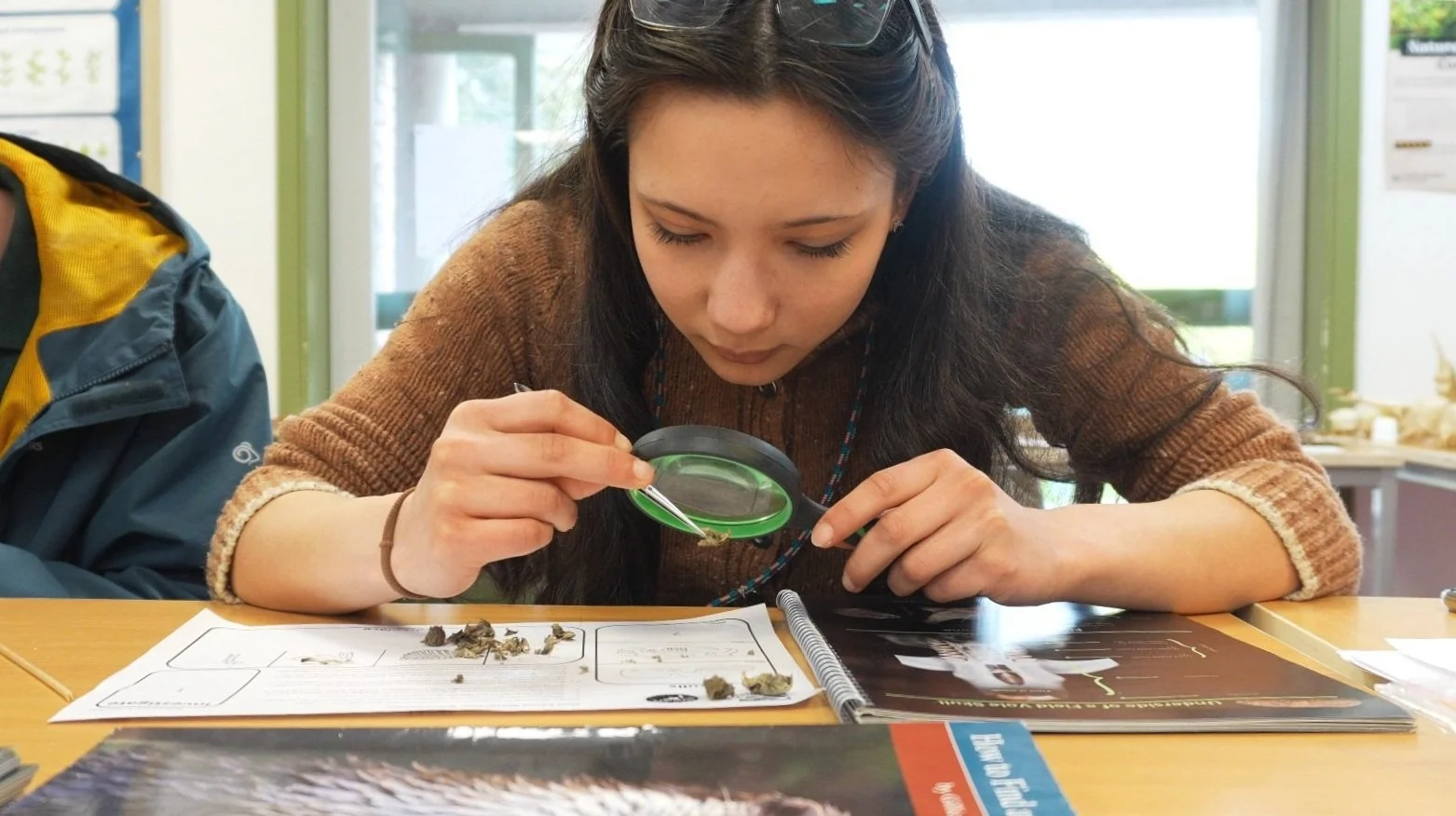
Photo: one of our Youth Ambassadors undertaking an owl pellet dissection
The Mammal Society has convened more than 20 signatories across the conservation, ecology, education and museum sectors to highlight to government and public the worrying trend of fieldwork opportunities disappearing from life science courses at UK universities. An open letter will be sent to ministers on Monday 12th May signed by representatives of conservation organisations, the ecological consultancy sector, universities and young people including Mammal Society Youth Ambassadors, UK Youth4Nature and award-winning author Dara McAnulty.
Fieldwork provides opportunities for undergraduates to gain hands-on experience of applying ecology knowledge and skills in a real-world context, ensuring that they can solve real-world challenges and recognise species, signs of wildlife presence and habitat health indicators.
Ecology consultancies have already reported to the Mammal Society a growing trend of career starters with life science degrees demonstrating insufficient field skills to be able to start working on projects without a period of shadowing experienced ecologists in the field.
The UK is considered severely nature-depleted based on data showing significant declines in species populations, habitat degradation, and the high number of species at risk of extinction. Since 1970, UK species have declined by about 19% on average (State of Nature 2023), and nearly 1 in 6 species are now threatened with extinction. Furthermore, only 14% of important habitats are considered to be in good condition. The government is committed to achieving a number of nature recovery targets set out in the Environment Act 2021 and Environmental Improvement Plan 2023, including the halting of species decline by 2030 and increasing species abundance by 10% by 2042, increasing tree canopy and woodland cover from 14.5% to 16.5% of total land area in England by 2050, restoring or creating more than 500,000 hectares of wildlife-rich habitat outside protected sites by 2042, restoring 75% of terrestrial and freshwater protected sites to favourable condition by 2042, and ensuring all sites of special scientific interest (SSSIs) have an up-to-date condition assessment, with 50% of SSSIs on track to achieve favourable condition by 31 January 2028. This represents a huge amount of work in the coming decades, for which a workforce of skilled ecologists will be essential.
Some institutions offer fieldwork opportunities to undergraduates but at an additional cost above course fees, or leave it up to students to find or create their own opportunities. This leads to an inequality of opportunity where students from more affluent backgrounds gain more skills valued by employers. A lack of inbuilt fieldwork can also make life science courses less attractive and have less perceived value for students considering a career path in ecology, at a time when we need more skilled people entering the workforce to address the challenges of the biodiversity crisis.
The letter below will be sent to government ministers across the devolved parliaments on Monday 12th May and published on the Mammal Society website. The letter calls for the following:
· Recognition of field courses as essential training.
· Commitment to maintaining and expanding field opportunities.
· Financial support to ensure equitable access so that no student is excluded due to cost.
· Sustainable alternatives, such as UK-based fieldwork options, rather than eliminating courses in response to carbon footprint concerns.
Letter - Re: Decline in fieldwork opportunities in life science courses
To: The Rt Hon Baroness Smith of Malvern, Minister of State (Minister for Skills)
Jenny Gilruth MSP, Cabinet Secretary for Education and Skills, Scotland
Vikki Howells, Minister for Further and Higher Education, Wales
Paul Givan MLA, Minister for the Department of Education, NI
As representatives of the ecological and environmental sector, we are deeply concerned about the decline of fieldwork opportunities in university life science courses. With tightening university budgets, it appears that field courses are increasingly seen as optional extras rather than a fundamental part of learning.
Field training is at the heart of life sciences. Hands-on experience in data collection, species identification, and ecosystem analysis cannot be fully replicated through virtual learning or AI-driven remote sensing. While technology is a valuable tool in conservation, real-world ecological expertise remains irreplaceable. Students increasingly seek these opportunities, recognising that practical skills gained in the field are essential for their academic and career development.
We understand that universities face financial constraints, however, cutting field work not only undermines the quality of ecological education but also risks producing a generation of graduates without the practical skills needed to tackle today’s pressing environmental challenges.
Across multiple institutions, we are already witnessing:
· Field courses being scaled back or removed entirely
· Reductions in subsidies, making participation unaffordable for many students
· Overseas field courses becoming prohibitively expensive, limiting exposure to global conservation issues.
These changes often hit students from lower-income backgrounds the hardest, deepening inequality in access to vital learning experiences. Many already self-fund aspects of their field training and expecting them to bear even greater financial burdens will only widen this gap. This added financial strain can leave students feeling powerless to voice their concerns, fearing it could jeopardise their academic or career prospects.
We urge universities to protect and prioritise fieldwork as a core component of ecological education.
Specifically, we call for:
· Recognition of field courses as essential training.
· Commitment to maintaining and expanding field opportunities.
· Financial support to ensure equitable access so that no student is excluded due to cost.
· Sustainable alternatives, such as UK-based fieldwork options, rather than eliminating courses in response to carbon footprint concerns.
Universities have a responsibility to equip graduates with the skills needed to address the biodiversity and climate crises. They are also uniquely positioned to level the playing field—ensuring that students who may not have had direct experiences in nature and ecology now have that opportunity. At a time when national initiatives are advocating for greater outdoor learning, it is deeply concerning that higher education institutions are moving in the opposite direction.
This letter is supported by leading NGOs, academics, students, and professionals across the environmental sector. We stand together in calling for urgent action to safeguard fieldwork as a cornerstone of ecological education.
Fieldwork is not a luxury—it is a necessity. We ask universities to reaffirm their commitment to practical ecological training and ensure that all students, regardless of background, have access to the field-based experiences they need to succeed.
Yours sincerely,
Matt Larsen-Daw, CEO, The Mammal Society
Fiona Day, Education & Community Engagement Lead, The Mammal Society
Dara McAnulty, Author, Naturalist and Life Science Student at Cambridge
Kerryn Humphreys, Editor, Countryside Jobs Service
Sally Hayns, CEO, Chartered Institute of Ecology and Environmental Management (CIEEM)
Paul Coulson FIFM, Chief Executive, Institute of Fisheries Management
Nida Al-Fulaij, Chief Executive, PTES
Kit Stoner, Chief Executive, Bat Conservation Trust
Mark Stead, Head of Learning, WWT
Dr Simon Dowell, Director of Conservation Science & Policy, Chester Zoo
Lyndon Howson, Youth Board Member, Chester Zoo
Anju Sarpal, Amphibian and Reptile Conservation (Arc)
Kathy Wormald, Chief Executive, Froglife
Anna Graham, Education Manager, Manx BirdLife
Rachel Jones, Learning Lead, Plantlife
Sue Sayer MBE, Seal Research Trust
Fay Vass, Chief Executive, British Hedgehog Preservation Society
Ellen Bradley, Co-Director, UK Youth 4 Nature
Jamie Agombar, Executive Director, Students Organising for Sustainability (SOS-UK)
Karen Letten, Schools & Communities Engagement Manager, Woodland Trust
Sasha Woods, Director of Science and Policy, Earthwatch Europe
Adam Donnan MIEnv Sc CEnv MBA, CEO, Institution of Environmental Sciences (IES) & Community for Environmental Disciplines in Higher Education (CEDHE)
Dr Andrew Kitchener, Principal Curator of Vertebrates, National Museums Scotland
Dr Fiona Mathews, Professor of Environmental Biology, University of Sussex
Professor Juliet Vickery, Chief Executive, British Trust for Ornithology (BTO)
Liane, on behalf of the Mammal Society Youth Ambassadors
Quotes from nature sector leaders, students, academics can be provided upon contact. For more information or to arrange an interview with a campaign spokesperson, please contact Mammal Society CEO Matt Larsen-Daw at: ceo@themammalsociety.org.