

By Lana Ishmukhametova
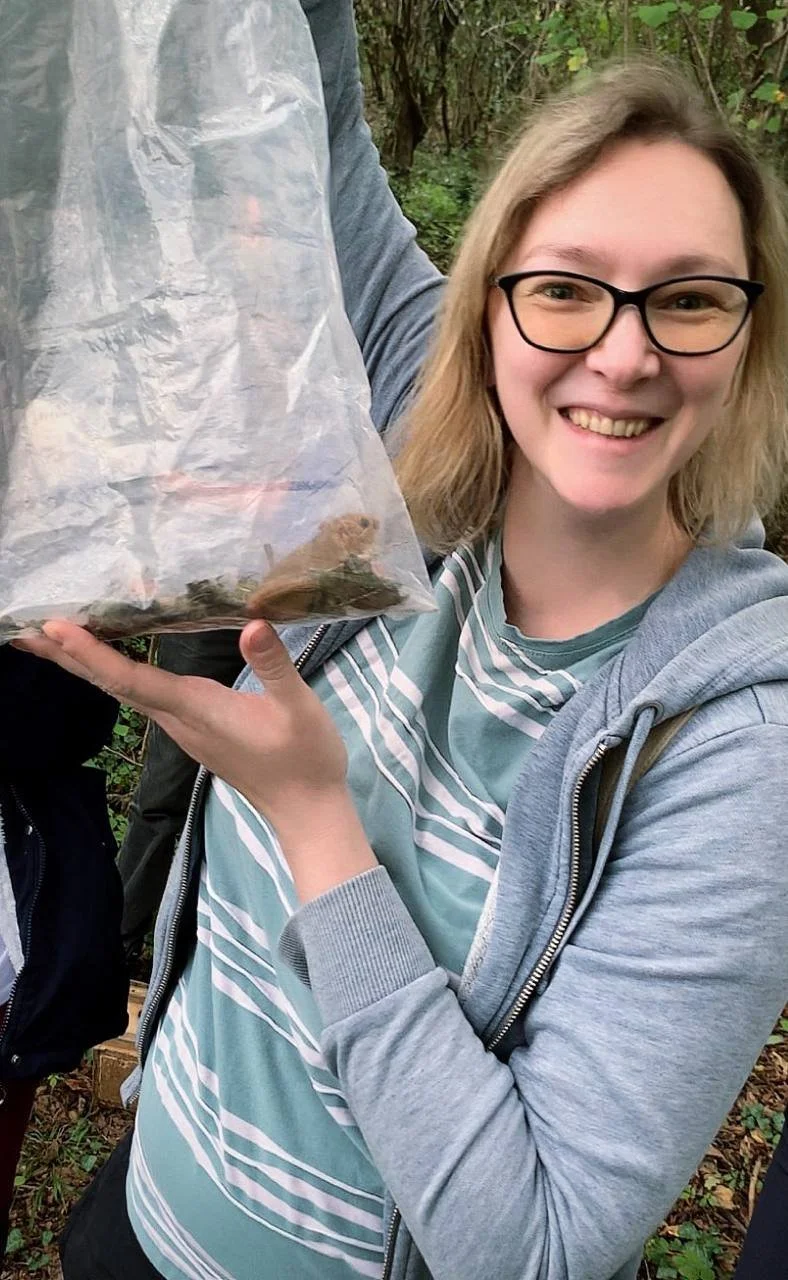
Hazel Dormouse, handled with the supervisor of a licence holder.
As a mature career-switcher now studying for an MSc in Wildlife Conservation at Anglia Ruskin University, I’ve taken a rather winding path to where I am today. Having grown up near the Polar Circle in Siberia, I never imagined that one day I would be learning about — or even seeing — a real dormouse in the wild. The road hasn’t been easy — in my forties I found myself starting over and rebuilding my career from scratch, in a field I have always truly loved. So when I learned about the Mammal Society’s Golden Ticket scheme, it felt like a perfect opportunity: not only to gain an amazing experience, but to remind myself that I am capable and deserving of this new path.
When I received the news that I had been awarded a Golden Ticket, I was overjoyed — it felt like winning the lottery! I immediately chose the Dormouse Ecology and Conservation course in Somerset. Dormice have fascinated me ever since childhood, when I first encountered the sleepy little creature in Alice in Wonderland. Back then, she seemed almost mythical — a tiny animal from a distant, dreamlike world. The chance to see one in real life, while learning how to help protect them, was beyond exciting.
The training took place at the beautiful Somerset Wildlife Trust reserve, led by course tutor David Wells, whose expertise and passion for these animals were truly inspiring. We began with a detailed theoretical session covering dormouse ecology, distribution, and conservation. We explored their life cycle, hibernation patterns, feeding behaviour, breeding habits, and habitat requirements. The classroom section also included an overview of relevant legislation, licensing requirements, and best practices for ethical fieldwork — particularly important for anyone hoping to become a licensed handler. As someone working toward a Dormouse Handling Licence, this information was invaluable.
After the theory, we headed into the field to put our knowledge into practice by checking dormouse nest boxes on the reserve. We were advised not to get our hopes up — after all, there was no guarantee any of the boxes would contain dormice at this time of year. The first box we checked brought an unexpected delight: a tiny pygmy shrew, the UK’s smallest mammal. The next few boxes were empty, though one held a beautifully crafted dormouse nest woven from leaves and grass — a sign that dormice had indeed been active in the area. Then came the final box... As David carefully lifted the lid, the entire group fell silent. Inside was a young dormouse, likely born in early summer. Her fur still had the slightly darker tones of youth, soon to change to the rich russet of adulthood. Seeing her up close was an unforgettable moment and a powerful reminder of how delicate and precious these animals are — and how vital careful monitoring is for their survival.
The experience also reminded me of the importance of accessibility in conservation training. Initiatives like the Mammal Society’s Golden Ticket make a real difference for those of us who may face financial, social, or personal barriers to entering the sector. In my case, it wasn’t just a free course — it was a confidence boost and a validation that my voice and perspective have value in this field. To anyone considering applying for a Mammal Society Golden Ticket: do it. Whether you’re a student, a career changer, or simply passionate about local wildlife, it’s a chance not only to gain practical skills but to be part of a community of people working to protect our mammals for generations to come.
Thank you to the Mammal Society for this incredible opportunity, to Somerset Wildlife Trust for hosting us, and to David Wells for sharing his expertise and enthusiasm throughout the day.
To book your place on a Mammal Society training course visit our events page here.