

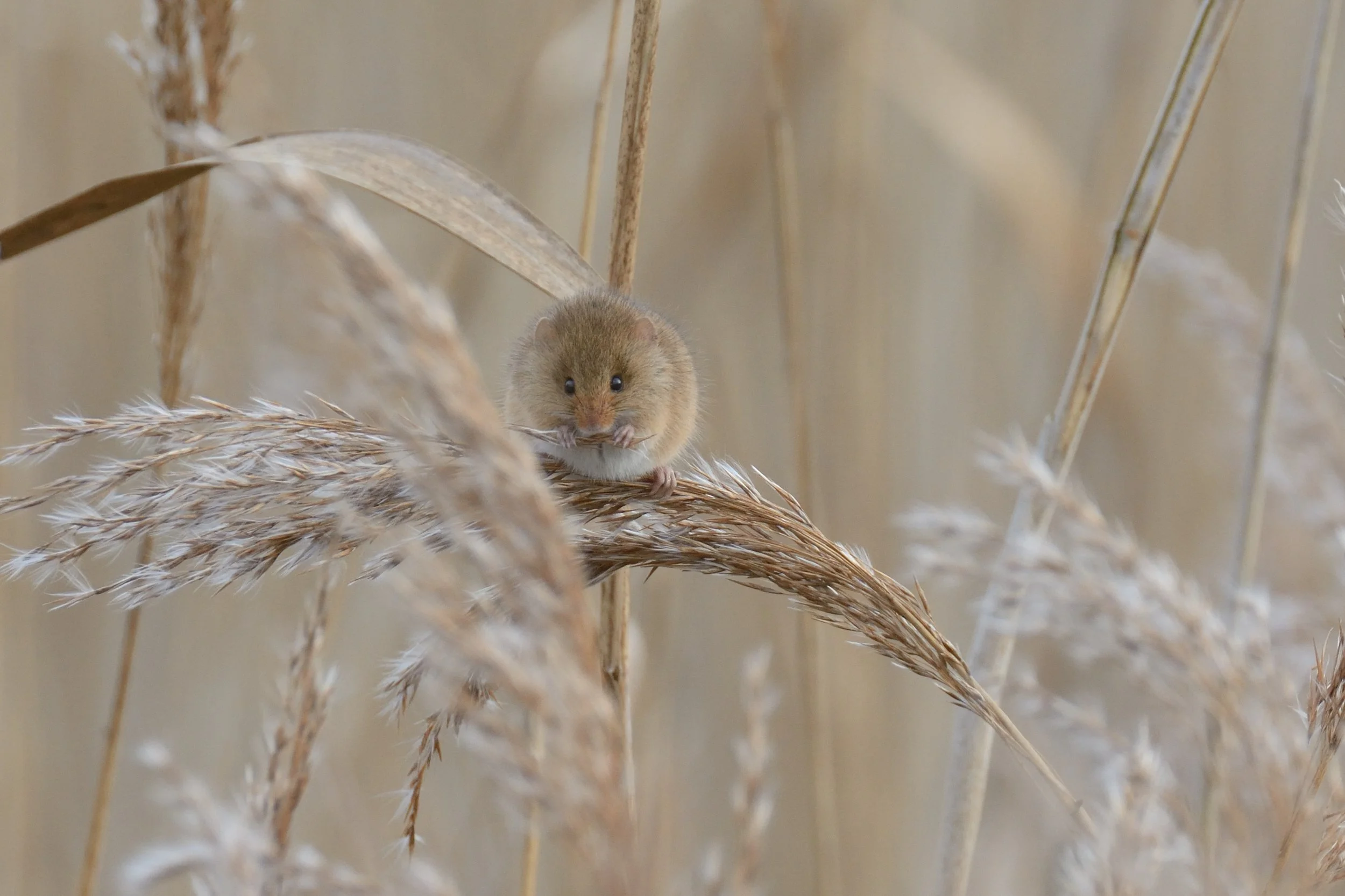
PC: Dennis Brown
Year four of the National Harvest Mouse Survey introduced a species distribution model to obtain new insights on the UK habitat suitability for the harvest mouse (Micromys minutus). Understanding harvest mouse distribution and factors that impact habitat use are essential to inform conservation and improve survey strategies.
Key Findings
The base survey statistics showed some changes compared to the previous survey year.
Firstly, the number of surveys decreased from 435 to 298. Secondly, a total of 1310 nests, down from 1618 in Year 3, were found, of which 768 were found during surveys. Conversely, the number of presence-only records showed a substantial increase compared to the previous season, climbing from 387 to 768. Geographical coverage displayed a negative trend: covered hectads decreased from 195 to 88, while tetrads lowered from 318 to 125.
The species distribution model generated a habitat suitability map for the Harvest Mouse in the UK and Northern Ireland, which can be found as Figure 3 in the full report.
Harvest mouse presence was closely related to moderate rainfall variability and stable temperatures. Extremes in either variable lowered habitat suitability.
Several areas with limited or no survey coverage that contain suitable habitat were identified. Amongst them were Lincolnshire, Nottinghamshire, Cambridgeshire, West Somerset, North Devon, North Wales and central Scotland.
Areas with high predicted suitability along the Welsh coastline are influenced by repeated, systematic surveys. A more even and randomized surveying strategy would reduce skewness of results and provide even more reliable data – this is key, as there may well be various suitable habitats that have not been surveyed. Indeed, the model predicted suitable habitats in areas without presence records; there could be more harvest mice throughout the UK than previously thought.
Recommendations
· To improve the reliability of the results and further knowledge of harvest mouse habitat use, the following steps are suggested.
· Areas identified as suitable but under-sampled should be prioritized for survey efforts to get a more accurate reading of national population status.
· Randomized survey routes or grid squares could be used systematically to avoid the repeated sampling of the same sites.
· Volunteer training and survey templates should be updated to include true non-detection (areas searched where no mice or nests were found).
· Habitat information and local land-use changes should be reported to help interpret distribution patterns.
Authors:
Sousa, B.; Clifton, R.; Priestley, A. (2025)