

Andrew Commins works as a Nature Reserves Manager for Natural England. Here, he tells us about his recent experience after being awarded one of the Mammal Society’s Golden Tickets.
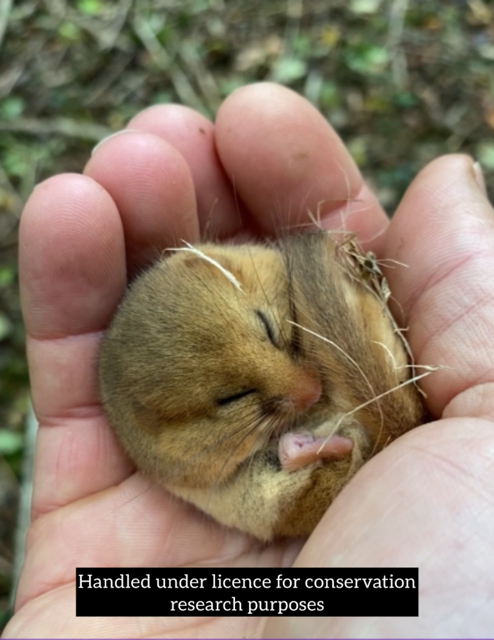
Hazel Dormouse in the hand. PC: Andrew Commins
Hi, my name is Andrew and I work as a Nature Reserve Manager for Natural England. I was lucky enough to win a Mammal Society ‘Golden Ticket’ gifting me a free place on the Dormouse Ecology & Conservation course. I have spent the last two years assisting with dormouse surveys on one of our reserves and, after progressing to conduct surveys as an accredited agent, I wanted to attend the course in advance of applying for my own licence. I was keen to get an up-to-date insight into dormouse ecology, nesting and breeding, and the course provided all I needed and more!
The course included modules on physiological adaptations for hibernation, feeding and breeding, population demographics, habitat preferences, conservation management techniques, territories, diet, survey methodologies and the law. It was a fantastic way to update my theoretical knowledge and an opportunity to get out into the field to follow along with an active survey (and we saw a dormouse)!
I was particularly interested in the recent research about habitat management, as the reserve on which I survey is divided into managed and non-intervention areas: and our dormouse survey is also split between these areas to see if there is a positive correlation between active management and dormouse presence and abundance. It was great to learn that dormice need actively managed habitats to provide them with the variety of food sources on which they rely throughout the year. Coppicing on rotation – which is part of our management – generates hazel stool of varying ages, which maximises the production of nuts. Glades and rides in woodland provide light to the ground, which enables the more delicate plants and scrub to flourish, which in turn provides the pollen and nectar sources that dormice rely on in the summer and autumn. And the varied flora ensures that invertebrates are available as an additional source of nutrition. I was also able to learn about nut-search surveys, which I will now undertake with my team of volunteers in a new habitat which may contain dormice (but as yet, untested)!
The training has been an excellent addition to my skills and in my application for a sole licence. I was able to update my training log to reflect my new learning. In addition, I can speak to volunteers and others who may accompany surveys in more depth about dormouse ecology, habitat preference and annual cycles. All of this knowledge is an excellent addition to my survey practice.
Dormice are under serious threat from habitat loss and fragmentation and a lack of areas managed actively and sensitively with their needs accounted for. They have suffered a 78% reduction in their population numbers between 1994 and 2020, and the more that can done now to survey for these special creatures and to protect and extend their habitats, the better.
So, great thanks to the Mammal Society for the opportunity to attend the course, and to the tutor for his excellent presentations on the day!
To book your place on a Mammal Society training course visit our events page here.