

Copyright Dan Bagur 2025
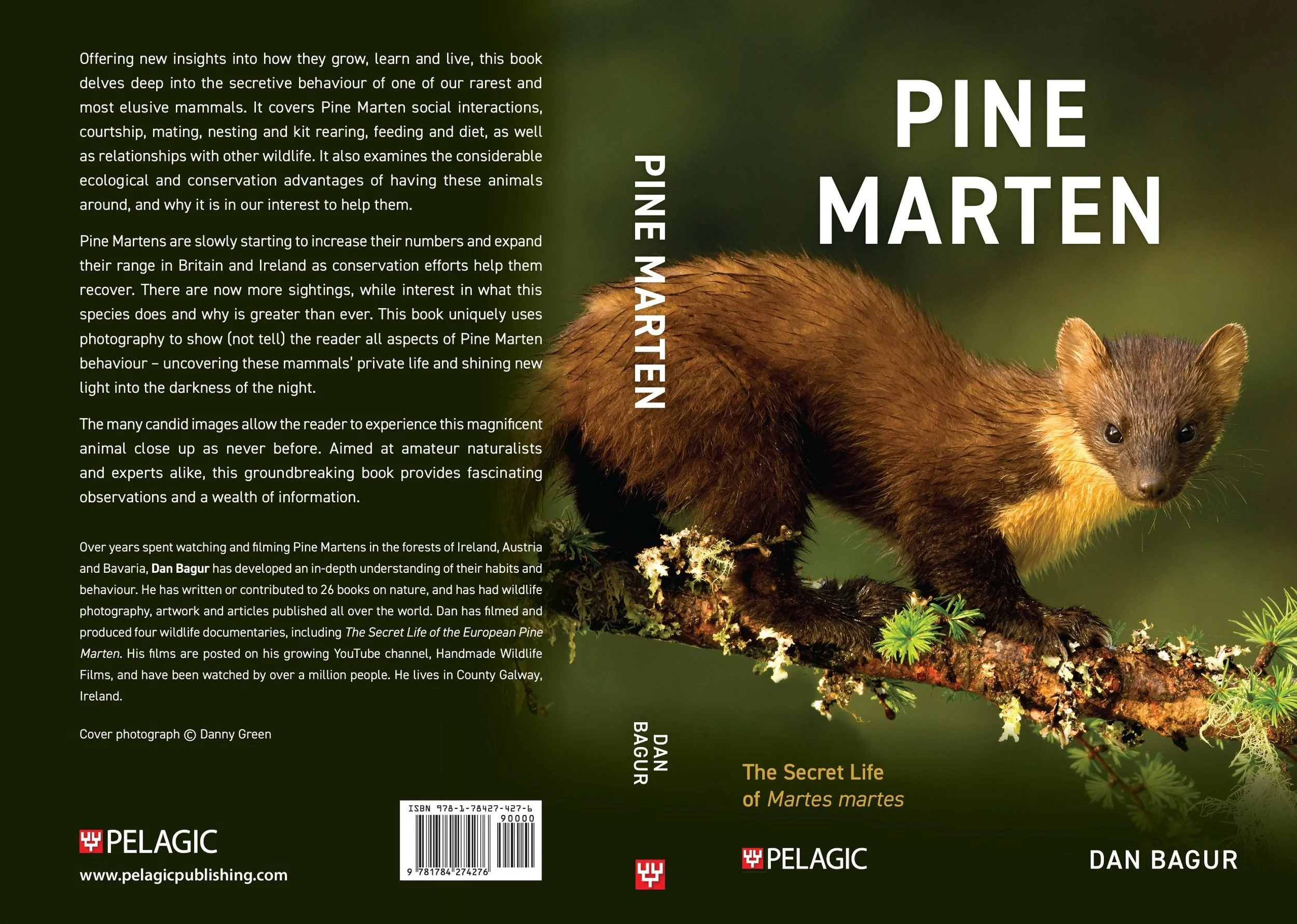
I found Pine Marten riveting and engaging from the beginning. The delightful paperback made an excellent bedtime read, even though I usually rest my eyes in the evening after a day of proofreading or editing wildlife publications. As there is so much readable factual information, I don’t want to miss out on anything, and feel compelled to read it all over again soon.
An ardent fan of the red squirrel, I was already intrigued by the mysterious pine marten, an alluring but largely unknown animal which inhabited the British countryside along with red squirrels for many thousands of years. Tragically, the pine marten was cruelly persecuted, almost made extinct in the UK through hunting and trapping, but – mostly in remote places such as a wood on the west coast of Ireland – it is possible to encounter a pine marten today, and whilst doing so, to rethink human attitudes towards untamed native wild creatures.
The author’s personal fascination with the animal is apparent from the start: ‘It was their wildness that hit me. When you first lock eyes with a Pine Marten, for a brief moment, you have become part of their wild, woodland world.’
I have heard that pine martens became extinct in my neck of the woods (Cornwall and Devon) before 1900, so before reading Dan’s book I knew very little about the species, although a delightful TV documentary about stone martens in France had made me very curious. I was yet to discover Dan’s film, available on You Tube: The Secret Life of the Pine Marten.
Copyright Dan Bagur 2025
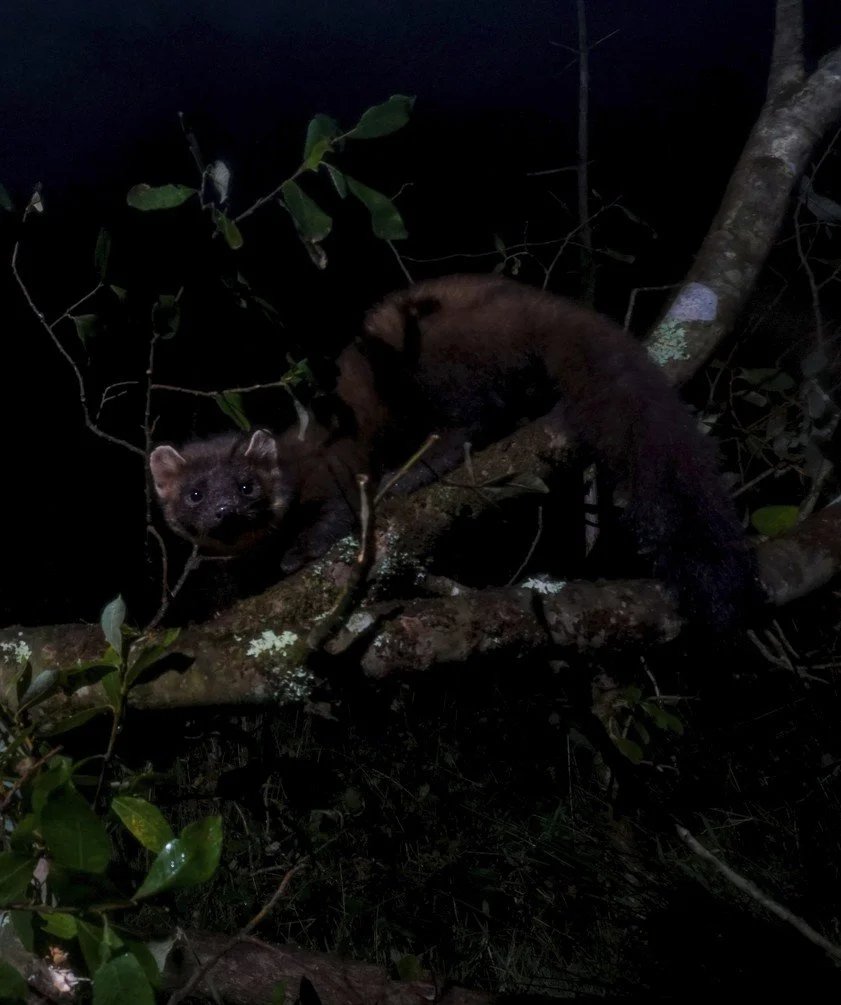
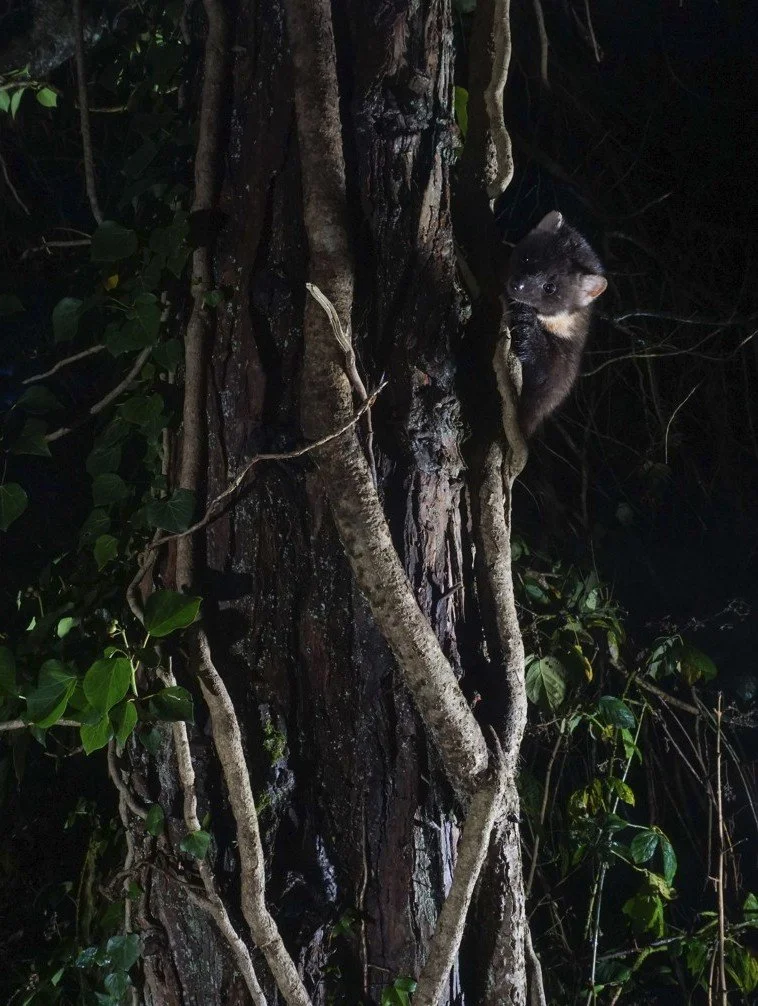
Following a move to rural Ireland, Dan spent five years observing local pine martens, which meant thousands of hours watching, including sitting deep in the woods at night – not a normal thing to do for most people in the 21st century. An aerial photo shows his home situated amongst what looks like quite extensive, largely conifer woodland. As he says, ‘The house itself is a wildlife hide.’ How wonderful. The reader feels simultaneously envious of the panoramic and all-consuming wildlife experiences he must have had, and aware of how cold, wet and uncomfortable he must have been on many occasions, alone (apart from wildlife encounters) for hours at a time.
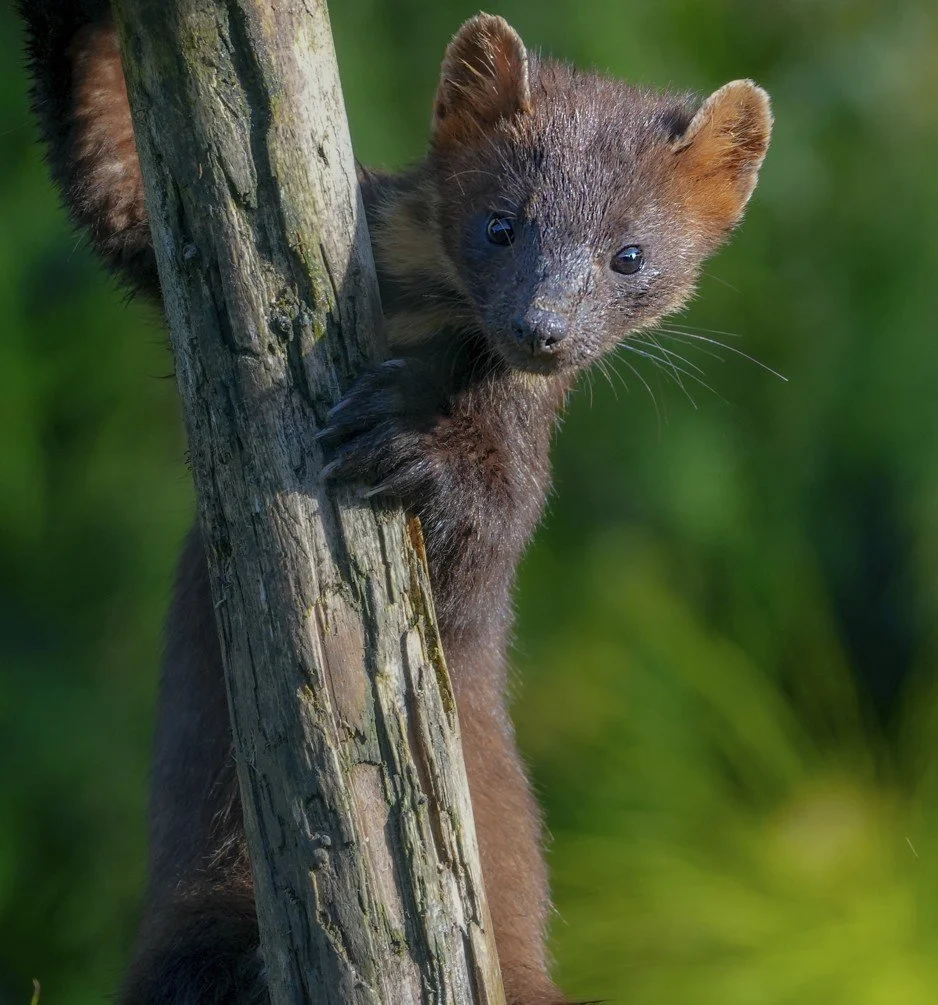
The narrative is written from the author’s perspective as an observer, whilst being crammed full of facts, references, and over 200 remarkable accompanying photographs, focusing on pine marten behaviour. There are many amazing colour shots of pine martens: peeping from behind branches, standing like a meerkat, showing off resplendent individually patterned bibs, jumping gracefully, or just standing there, alert and intelligent, personable and characterful.
Thought went into dividing the narrative into chapters discussing different aspects of pine marten life and behaviour: adaptation, morphology, nesting and kit rearing, feeding and diet, communication and social behaviour, ecological benefits of pine martens, predators and threats, tracks and signs, scats (these turn out to be much more than just tracks and signs!), pine marten photography, and helping martens.
Copyright Dan Bagur 2025
Reading Dan’s book was a revelation. He explains everything anyone ever wanted to know about pine martens, right down to the reason for the curly shape of the scat. (I was delighted to find a likely pine marten scat in the middle of a quiet path on a quite rewilded estate in Stirlingshire during a recent holiday – a place where we also encountered red squirrels and osprey.)
The amount of detail is incredible, and there are references aplenty, yet despite being authoritative, it’s an entertaining read throughout. I was interested to read about the favourite foods of this native omnivore. Dan has conducted experiments to find out such things for himself (not necessarily rigorously scientific, but interesting nonetheless). The book also has a very up-to-date aspect: it’s possible to scan a series of bar codes in one chapter, to hear the wide range of sounds made by pine martens. This, for me, is a whole new capability that can be offered by printed books as well as electronic devices.
The final chapter is about helping martens – a very important aspect if we want to experience them for ourselves in the future. This chapter will be useful for conservationists and the public as pine martens recolonise, as we can learn to provide them with the conditions they need to survive and thrive. For example, we have lost a great many ancient, dead trees that provide vital nesting spaces and so humans need to make up for this by providing suitable alternatives.
Although I have learnt so much by reading Dan’s words, eagerly studying his pictures and listening to the pine marten sounds, he tells the reader that there is still much to learn and there are many as yet unanswered questions about pine martens and other wild animals. I love the final sentence of the book. You should find a copy of Pine Marten by Dan Bagur to read it for yourself.
Copyright Dan Bagur 2025
Review by Rowena Millar, Editor, Mammal News
Book published by Pelagic Publications