

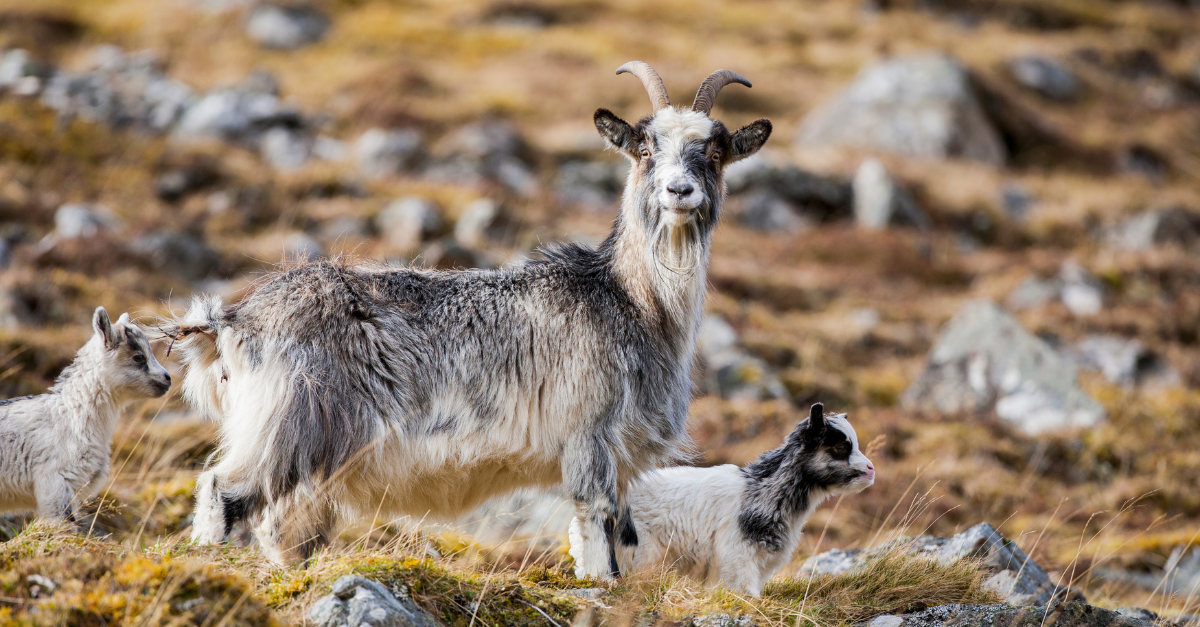
Feral goats (Capra hircus) are a non-native species in Britain, with small, free-living populations scattered across upland landscapes. Here, ‘feral’ simply means animals of domestic origin that now live and breed independently of people, self-sustaining and no longer reliant on humans. Some say it’s thought that domestic goats were first brought over by Neolithic farmers as far back as 5,000 years ago. The herds we see today, however, likely trace back to around 200–250 years ago, when goat-keeping declined in the 18th century and animals were left to roam and adapt on their own.
For the taxonomy enthusiasts among us, their place in the animal kingdom looks like this:
Kingdom: Animalia
Phylum: Chordata
Class: Mammalia
Order: Artiodactyla
Family: Bovidae
Genus: Capra
Species: Capra hircus
Feral goats tend to be found in steep, rocky slopes, moorland fringes, and coastal cliffs, selecting habitats that provide both shelter and access to food. Their distribution is shaped by environmental limits; at high latitudes they are strictly diurnal, constrained by short winter daylight and low temperatures, and tend to live well below the highest altitudes available. Feral goats are built for tough terrain. Their strong, cloven hooves give them excellent climbing ability, and they thrive in landscapes where other grazers might struggle. Their diet changes with the seasons: in summer, they graze dwarf shrubs, grasses, sedges, and rushes, while in winter they turn to herb-rich heath, Calluna heath, tree bark, and even seaweed along coastal edges. By feeding in this way, goats can influence plant communities and shape the habitats they live in. On the Isle of Rum, they are most often found along western coastal margins and cliff terraces, while studies in the Cheviot Hills show that herds favour lower elevation acid grasslands where food and shelter are more reliable. In poor weather, they may move downhill to find cover, and in coastal areas they are known to head onto beaches to graze on seaweed.
Their social lives are just as fascinating. Feral goats form groups called “hefts,” usually made up of females and their young, with males joining during the rut in late August to September. For much of the year the sexes remain separate, but during the breeding season males compete for access to females. Group size and structure shift with the seasons: on Rum, groups are smallest in winter and largest in summer. These hardy animals survive thanks to physiological traits such as low metabolism, efficient digestion, and minimal water requirements. Combined with their adaptability, this makes feral goats a resilient and long-lasting feature of Britain’s upland landscapes.
Vantage point survey
This September, the Mammal Society will be carrying out a Vantage Point Survey of feral goats in the Langholm and Newcastleton Hills, Dumfries & Galloway spanning 30,000 acres. The survey aims to produce a population estimate and also test how effective vantage point counts are for monitoring feral goats in upland terrain. The work is weather dependent, but if conditions allow, it will give us valuable insights into both the goats themselves and the best ways of surveying them.
Volunteer surveyors will work in pairs, travelling to pre-selected vantage points to scan the landscape using binoculars or scopes, record herd details, and take photographs to help verify sightings. The survey will involve moving across uneven or challenging terrain, so participants should be prepared for outdoor conditions. Both training and guidance will be provided, no specialist experience is required, just a love for wildlife and the outdoors!
Dates: Saturday 27 & Sunday 28 September
Location: Langholm & Newcastleton Hills, Dumfries & Galloway
If you would like to get involved and take part in the survey, please send us an email: science@themammalsociety.org