

Home / British mammals / Harbour seal

Harbour seal
Scientific name: Phoca vitulina
Fine spot-patterned grey or brown fur; rounded head with no ears visible; 'V' shaped nostrils and long whiskers.
Habitat: Coastal & marshland
Size: 140-185 cm including flippers of about 20 cm.
Weight: 8-16 kg at birth; up to 130 kg in adults.
Lifespan: Females can reach 30 years, but males are unlikely to survive beyond 20 years.
Origin and distribution
Common seals feed at sea but regularly haul out on to rocky shores or inter-tidal sandbanks to rest, or to give birth and to suckle their pups. The most important haul-out areas for common seals are around the coast of Scotland, particularly in the Hebrides, Orkney and Shetland, and on the east coast of England in the Wash, also around Strangford Lough and in SW Ireland.
Diet
Common seals are known to eat a wide variety of fish, including herring, sand eels, whiting and flatfish. Shrimps and squid are also sometimes eaten.
Ecology
Young seals may travel distances of several hundred kilometres but adults appear to remain faithful to favoured haul-out areas from year to year. The particular sites used may however vary with the seasons. Common seals travel up to 50 km from haul-out sites to feed and may remain at sea for several days. Here they spend time diving, staying underwater for up to 10 minutes, and reaching depths of at least 50 metres. The way in which common seals hunt is poorly understood.
Breeding
Females give birth to a single pup in June or July each year. Pups are very well developed at birth and can swim and dive when just a few hours old. This enables common seals to breed in estuaries where sand-banks are exposed for only part of the day. Mothers feed their young with an extremely rich milk and pups grow rapidly, doubling their birth weight during the three or four weeks that they suckle.
Conservation status
The common seal is in fact less common in British waters than the grey seal, at about 55,000 compared with around 120,000 grey seals, but around Ireland the two species are more equally represented: about 3,000 common seals and 4,000 grey seals. The Conservation of Seals Act (1970) protects common seals during their breeding season, although seals causing damage to fishing gear, or taking fish from nets, may be killed under licence. The Act also allows seals to be fully protected when required. Following the 1988 seal plague, common seals in England, Wales and Scotland were given year-round protection.
Common seal pups used to be hunted for their skins, particularly in Shetland and in the Wash. This probably over-exploited populations in some areas and led to the seals being protected in 1970. There is continuing controversy over the impact that seals might have on fish stocks although, in Britain, grey seals have received more blame from fishermen than common seals.
Seals are at the top of the food chain and so tend to accumulate pollutants such as heavy metals and polychlorinated biphenyls (PCBs) which are persistent in the environment. Female common seals feeding on fish with high levels of PCBs may fail to breed and pollution could thus hinder the recovery of some populations which have been reduced by disease.
Identification
Colour extremely variable. Rounded head, which is small in relation to body. V-shaped nostrils that almost meet at bottom. Head is more blunt and puppy-like than grey seal. Often adopts characteristic ‘head up, tail up’ position when hauled out. Large male adult common seals can be up to 1.8 m in length.
Confusion species
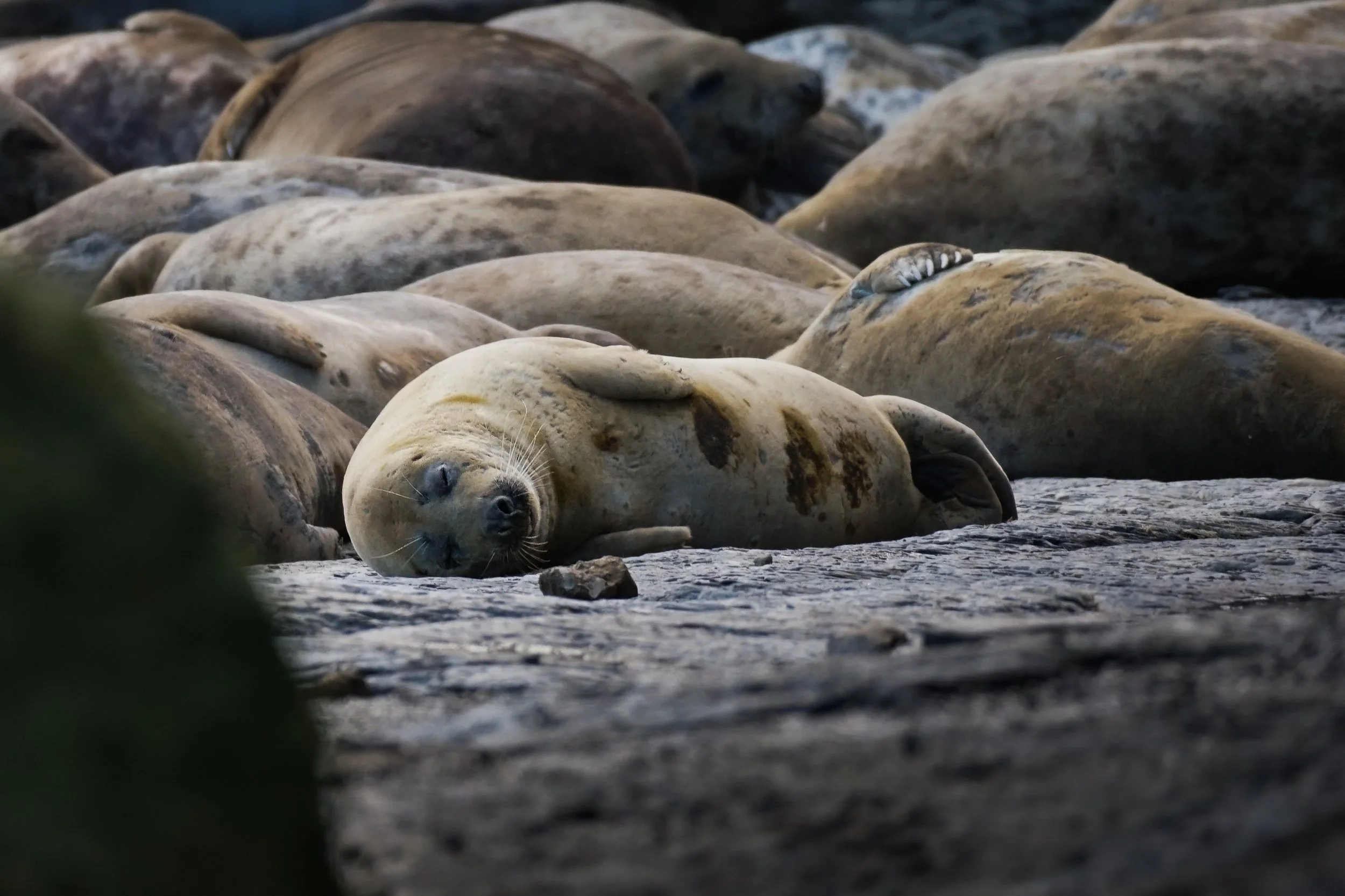
Grey seal (Halichoerus grypus)
Long, straight muzzle, compared to shorter rounded muzzle of common seal. Nostrils almost parallel and set further apart than common seal, which has v-shaped nostrils set closer together.