

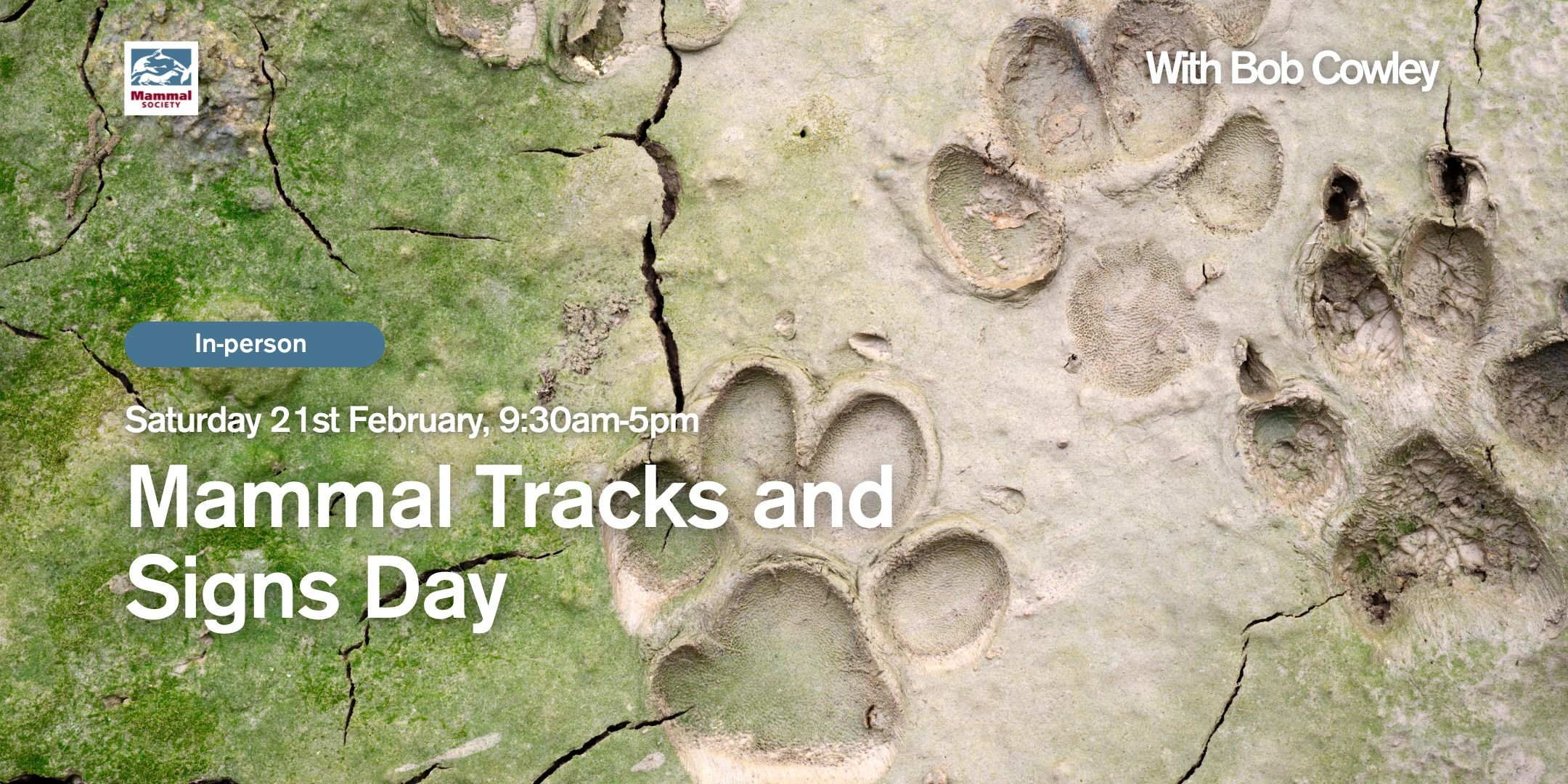
In this popular one-day Foundation Course, expert tracker Bob Cowley will introduce you to all the most common Mammal Tracks & Signs that you might come across when walking in the British countryside, revealing the wildlife with which we share our space.
Whether you are a complete beginner or an experienced naturalist, this course will open your eyes to the wide range of Tracks and Signs in the world around you, and provide you with a systematic approach to interpreting them correctly. Bob will use an innovative combination of PowerPoint presentations together with the study of actual specimens from the Museum collection to help you visualise and associate the different animals with their different tracks.
Bob is also well known for the range of useful verbal mnemonics and visual tricks that he has devised to ensure that all the important information will stick in your mind long after the course has ended. Finally, Bob will lead a guided walk to show you how to find and interpret examples in the real world.
Location: Oxford University Museum of Natural History, Parks Road, Oxford OX1 3PW
9.30 – Registration & Introductions
Session 1 (9.45-11.45) – Mammal Anatomy & Tracks:
How can you distinguish between the most common tracks in the UK countryside?
What are the important characteristics of a footprint?
How are the characteristics of a footprint determined by the anatomy of different groups of mammals?
What can a set of prints tell you about the way an animal was moving, and how might that help define the species?
Session 2 (12.45-2.45) – Mammal Behaviour & Signs:
In what ways does an animal’s lifestyle and behaviour impact the environment?
If you find some bones, or perhaps a skull, how can you tell what species they came from?
What can you tell about an animal’s lifestyle from its skull, teeth, or other bones?
Bob Cowley’s famous “Simplified Guide to Holes in the Ground”.
When you see some droppings on the ground, how can you identify the species responsible?
How do the feeding habits of different animals leave distinctive signs for you to find?
What other behaviours can lead to characteristic damage to plants, trees, or ground?
Session 3 (3.00-5.00) – Finding Tracks & Signs in the real world:
Bob will lead a guided walk through the University Parks and alongside the River Cherwell, to find and discuss some actual examples of Tracks and Signs in the real world.
Please come prepared with footwear suitable for possibly muddy conditions and clothing that will keep you warm and dry for two hours outdoors.
Catering:
Participants are responsible for their own lunch and refreshments, but there is an excellent cafe on site, which serves a wonderful range of tasty, planet-friendly meals, drinks, and snacks.
Trainer:
The trainer for this course will be Bob Cowley.
Bob Cowley has always been fascinated by the Tracks & Signs that animals leave behind as evidence of their presence. And since the International Tracker Certification scheme (also known as CyberTracker) reached the UK in 2012, Bob has been one of its most active participants and advocates. He is now one of the few “Level 3 Trackers” in Europe, having been certified at that level in both the tracking disciplines, “Track & Sign” and “Trailing”.
As well as learning all he can about this neglected ancient skill, Bob is equally committed to passing on that knowledge. A good understanding of Track & Sign is an invaluable asset for any professional ecologist, zoological researcher or student, as well as being an excellent way of connecting people to the wildlife that lives around them.
In addition to the Mammal Society, Bob has led workshops for a variety of other local and national organisations, including the Field Studies Council, the Woodland Trust, and Oxford University. He has also been an invited speaker at the International Tracking Symposium every year since its inception in 2022, and is in daily contact with other elite trackers from all over the world.
Bob has been involved in the Oxfordshire Mammal Group since its formation in 2014, currently serving as Vice Chair. He has been particularly involved with OxMG’s outreach and education work, organising public talks, both in-person and online, and establishing a dedicated YouTube channel to enable the talks to reach a wider (indeed world-wide) audience.
A CPD certificate will be available on completion of the course.
Beginner/Intermediate level: This event can be attended by people who have little to no pre-existing knowledge of the topic, but is also ideal for those with experience who may not have attended a formal course and wish to develop their understanding.
Concession tickets: available for those in education or those on a low income/in receipt of universal credit.
Accessibility:
We are committed to ensuring the accessibility of our training courses. If you require accommodations or have any accessibility concerns, please contact training@themammalsociety.org in advance, and we will be happy to assist you.
For booking terms and conditions click here.
Please note - As a small charity, we need to ensure our events are viable. Because of this, events may be postponed with two weeks' notice if not enough delegates book onto a course.