

By Eve Rowson
I am easily swayed to love any wildlife, however my original draw into nature was mammals. Being raised by David Attenborough documentaries I witnessed the amazing diversity of mammalian life, saw complex behaviours and social relationships through the TV and knew from a very young age that I wanted to help preserve this.
I went on to study Applied Zoology at Newquay University Centre and am now a resident volunteer for the Lincolnshire Wildlife Trust. Like many recent graduates with the aim of entering a career in conservation, I feel like I am in a constant battle to gain experience. The Mammal Societies courses offer the perfect entry-point for exploring new species, but for me receiving the Golden Ticket removed the biggest barrier of cost, and having the option to partake in an online course was especially useful as it meant I could gain the same level of knowledge from my living room.
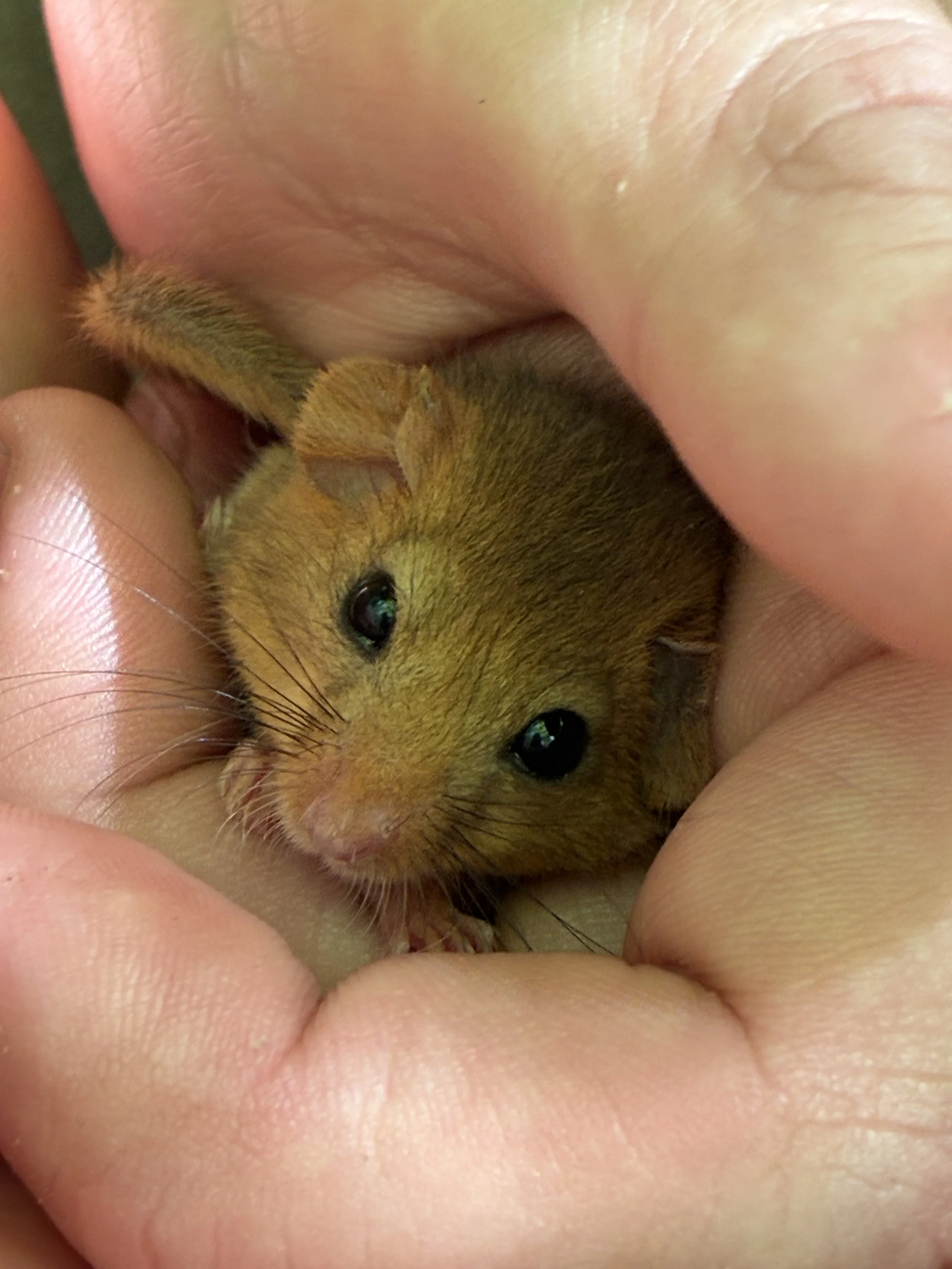
I picked the online Dormouse Ecology and Conservation course purely out of curiosity. I didn’t know much about hazel dormice but have always had an affinity with rodents and other overlooked mammals.
David Wells led us through the basics of what makes a dormouse, going on to discuss their behaviour (including their well-known love for sleeping), ecology, legislation, habitat and licensing requirements. Of course, some online courses can be difficult to maintain focus throughout, however David did a fantastic job of communicating his fascination of dormice. I loved hearing about some of the unexpected locations they can be found including hedgerows and more recently along a green bridge over the A21. It’s remarkable how resilient such a tiny creature can be in the face of human disturbance, habitat loss and degradation and climate change.
Despite the name ‘hazel dormouse’, they will happily live amongst willow, blackthorn, sycamores, oaks, bramble, honeysuckle and many other trees as they eat their catkins, berries and pollen. What they actually need is structural complexity of the woodland canopy. They can only pass gaps of up to 30 meters and so spaces larger than this risk fragmenting populations. This means that maintaining a connected canopy is the greatest priority for dormouse conservation, but in balance it can’t be too dense as otherwise sunlight cannot get through to shrubs in the understory. The course has definitely given me a better appreciation of the role woodland management plays in dormouse conservation and conservation in a broader sense. I think oftentimes, coppicing or cutting down trees can appear counterintuitive, and that many people have a perception that woodland is peak nature, however it’s much more complex than this.
What was previously a personal interest has now been transformed into practical ambition, where I am training with the Lincolnshire Dormouse Group at Chambers Farm Woods to gain my dormouse handling license. The group monitor the native and reintroduced population contributing towards the National Dormouse Monitoring Programme for PTES, as well as helping Forestry England with Winter habitat management tasks.
The mice so far have been very active, likely as they are a fan of the sunnier, drier weather and are taking the opportunity to arise from their hibernation a bit earlier. On our last survey we found 2 pregnant females, as well as a pair nesting together (likely male and female- one very frantic mouse shot up a tree before we could sex them!). However a lot of the boxes are currently occupied by blue tit, great tit and wren chicks and so we will expect to find more mice once they have fledged.
My advice to anyone applying for the Golden Ticket is to really emphasise your curiosity and passion. Volunteering is one of the best ways to demonstrate this as well as gain additional experience. Although it is not always accessible, there are many opportunities that are remote and ad-hoc and so fit around life much easier. I have been a Communications Officer for the Hull Mammal Group for several months now and I really enjoy expressing my love for nature through more creative means and sharing this with likeminded people. I would recommend anyone wanting to apply for the Golden Ticket to reach out to your local mammal groups to see how you can help them. So much goes into running these groups, so if you have skills in finance, art, communications (almost anything goes!), reach out.
Thank you so much to the Mammal Society and David Wells. This experience really has been invaluable, and I am starting to finally feel some momentum build in my goal to work in conservation. No longer is nature locked behind a TV screen for me- I am now a small part of dormouse conservation thanks to the confidence and knowledge I gained through this course.